

















Article Contents:
- Psychology of Space: Why Wall Decor Changes Us
- Visual Enrichment vs. Sensory Deprivation
- Structure and Order: How Molding Soothes
- Depth and Volume: The Play of Light on Relief
- Materials and Tactility: Wood vs. Plastic
- Cultural Codes: Classic vs. Minimalism
- Polyurethane Molding: Architecture on a Plane
- History of Molding: From Stone to Polymers
- Creating Frames: Basic Wall Decor Technique
- Boiserie: French Elegance of Wall Panels
- Molding Layout Schemes: The Mathematics of Beauty
- Installation Technology for Polyurethane Molding
- Mistakes to avoid
- Wooden Decor: Warmth, Texture, Tradition
- Carved Overlays: Small Forms of Great Art
- Rosettes: Circular Perfection
- Wooden Slats: Modern Accent Wall
- Installing Wooden Decor on Walls
- Using Decorative Elements: Composition Schemes
- Symmetry: Classical Harmony
- Asymmetry: Modern Dynamics
- Rhythm: Repetition and Variation
- Accents: Focal Points
- Proportions: Golden Ratio and Simple Fractions
- Modern Aesthetics vs. Classical Canons
- Classical Interiors: Abundance and Ornament
- Modern Interiors: Minimalism and Accents
- Transitional Styles: Neoclassical and Fusion
- How to Choose Your Style
- Practical Tips: Ideas and Implementation
- Idea 1: Accent Wall Behind the Bed Headboard
- Idea 2: Panel Gallery in the Hallway
- Idea 3: Slatted Accent Wall in the Living Room
- Idea 4: Classic Wainscoting in the Study
- Where to buy quality materials
- Frequently Asked Questions About Wall Decor
- Can Decorative Elements Be Used on Uneven Walls?
- How Much Does Wall Decorating with Molding Cost?
- How Long Do Decorative Elements on Walls Last?
- Can Elements Be Removed Without Damaging the Wall?
- Are decorative elements suitable for wet areas?
- How to choose the color of elements?
- Can polyurethane and wood be combined?
- Are special tools needed for installation?
- Can a rented apartment be decorated?
- Conclusion: walls as the canvas of your story
- STAVROS: the workshop where details are born

A wall. A flat vertical surface separating the inside from the outside, one room from another. It might seem—what's so special about it? But walls occupy most of the visible space in any room. And they are often the most underestimated, neglected, simply painted in a neutral color or covered with wallpaper. Yet, properuse of decorative elementscan radically change the perception of space, turning an ordinary room into a space with character, individuality, and soul.
Why do some interiors stay in memory, while others are instantly forgotten? Why do we want to stay in some spaces, but in others—to leave as soon as possible, even if the furniture is expensive and the renovation is fresh? The answer often lies in the details, in that very work with walls that many ignore.Wall decor elements— these are not just decorations, they are tools for creating visual dramaturgy, ways to tell a story, ways to imbue a blank plane with meaning and emotion.
In this article, we will dive into the world of wall decor. We'll start with psychology — how the brain perceives decorated surfaces, why they affect our mood and well-being. Then we'll move on to practice: we'll study Moldings made of polyurethane, creating frames and panels on walls, explore Wooden decoration with its warm texture and carved ornaments, analyze layout schemes — symmetry, rhythm, accents. We'll compare how decorative elements work in classic and modern interiors. And, of course, we'll give practical recommendations: where to buy quality materials, how to bring ideas to life.
Ready to transform your walls? Then let's begin.




Psychology of space: why wall decor changes us
The human brain is a pattern recognition machine. We evolved in an environment rich with visual information: trees, rocks, bodies of water, clouds. Our brain is accustomed to processing complex textures, shapes, and depth. And when we find ourselves in an environment poor in visual stimuli — for example, in a room with smooth white walls — the brain receives too little information. This causes discomfort that we don't always consciously recognize, but always feel.
Visual enrichment versus sensory deprivation
Psychologists have established: rooms with visually complex surfaces are perceived as more interesting, comfortable, 'alive'. Complexity does not mean chaos — it is structured diversity. A wall with moldings forming panels gives the eye many anchor points: vertical lines, horizontal lines, frame corners, the inner space of panels. The eye travels along these elements, the brain processes information, we feel engagement.
A smooth, monochromatic wall presents the eye with a single plane, one color, zero depth. After a few seconds, the gaze tires, slides further, finding nothing to latch onto. The room feels empty, cold, temporary—like a hotel room where we sleep but do not live.
Our factory also produces:


Структура и порядок: как молдинги успокаивают
An interesting paradox: adding elements to a wall does not complicate perception but simplifies it. Because moldings, panels, frames create structure, order, hierarchy. The wall ceases to be an endless plane—it becomes a system of zones, each of which is understandable, bounded, complete.
This works on a deep level. The human brain loves order, predictability, symmetry—they signal safety, stability. Chaos is frightening because danger is hard to predict in chaos. When we enter a room with ordered wall panels, with symmetrically arranged elements, the brain reads: everything here is under control, we can relax. We don't consciously realize it, but we feel it as increased comfort.
Get Consultation
Depth and Volume: The Play of Light on Relief
A flat wall reflects light uniformly. A wall with relief decor—moldings, carved overlays, pilasters—creates a play of light and shadow. With side lighting (from a window, sconce), protruding parts lighten, recessed parts darken. A gradient, volume, an illusion of three-dimensionality arises.
This play of light is dynamic: it changes throughout the day as the sun moves, changes when artificial lighting is turned on. The wall becomes alive, breathing, responsive to environmental changes. We subconsciously perceive this as naturalness—after all, in nature, everything changes, everything is in motion. Staticness, on the contrary, is associated with artificiality.
Materials and Tactility: Wood vs. Plastic
Visual perception is closely linked to tactile perception. Even without touching a surface, we 'know' what it feels like—smooth or rough, warm or cold, alive or dead.Wooden wall decorWood is perceived as warm, natural, friendly. Wood has been part of the human dwelling for centuries, our brain is accustomed to it, trusts it.
Polyurethane, a modern polymer, can visually mimic any material but remains plastic to the touch. This is not a flaw—it's a different aesthetic. Polyurethane is associated with modernity, technological sophistication, and lightness. In classic interiors, wood is preferable; in modern ones, polyurethane is organic.
Cultural codes: classicism versus minimalism
The perception of decor is deeply culturally conditioned. In the European tradition, an abundance of decorative elements on walls is associated with wealth, status, and education. Palaces, mansions, and temples have always been decorated with stucco, carvings, and panels. A person entering a room with such finishes reads the cultural code: 'people of taste and means live here.'
In contemporary culture, especially under the influence of Scandinavian design and Japanese minimalism, an alternative code has formed: minimal decor = sophistication, mindfulness, focus on the essential. Smooth walls are perceived not as poverty but as a choice, a philosophy.
It's important to understand which audience you are creating the interior for. For people with a classic upbringing who value traditions, the absence of wall decor may seem unfinished. For a generation raised on minimalism, an abundance of moldings may be perceived as excessive. There is no right or wrong—only alignment or misalignment with cultural expectations.
Polyurethane moldings: architecture on a plane
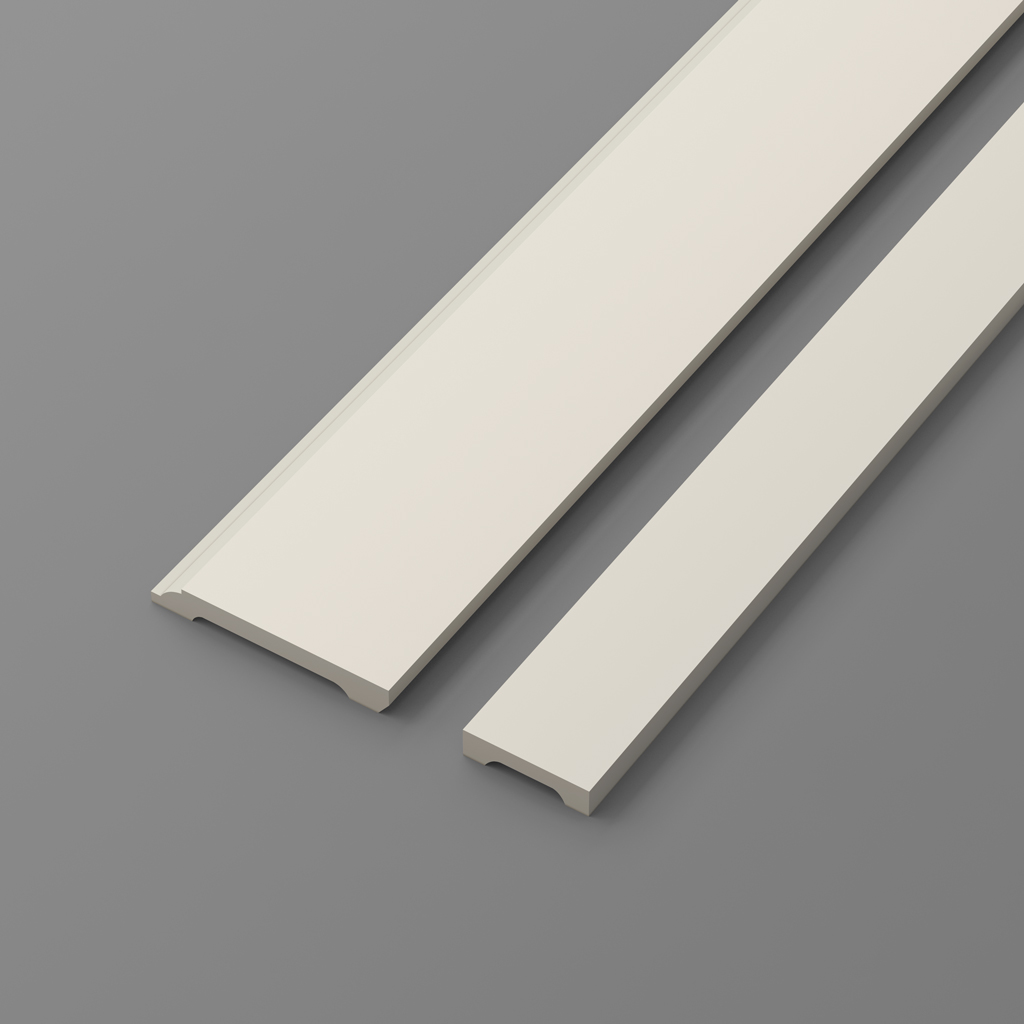
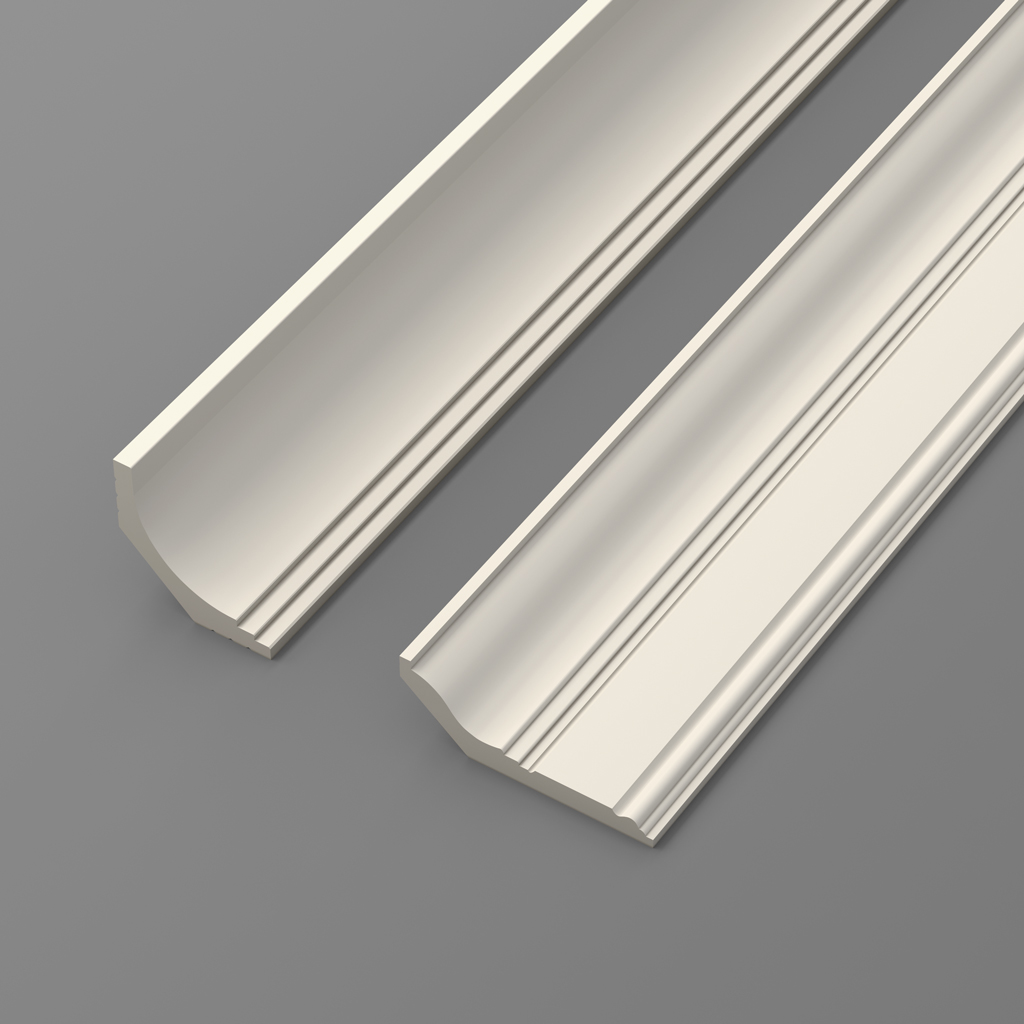
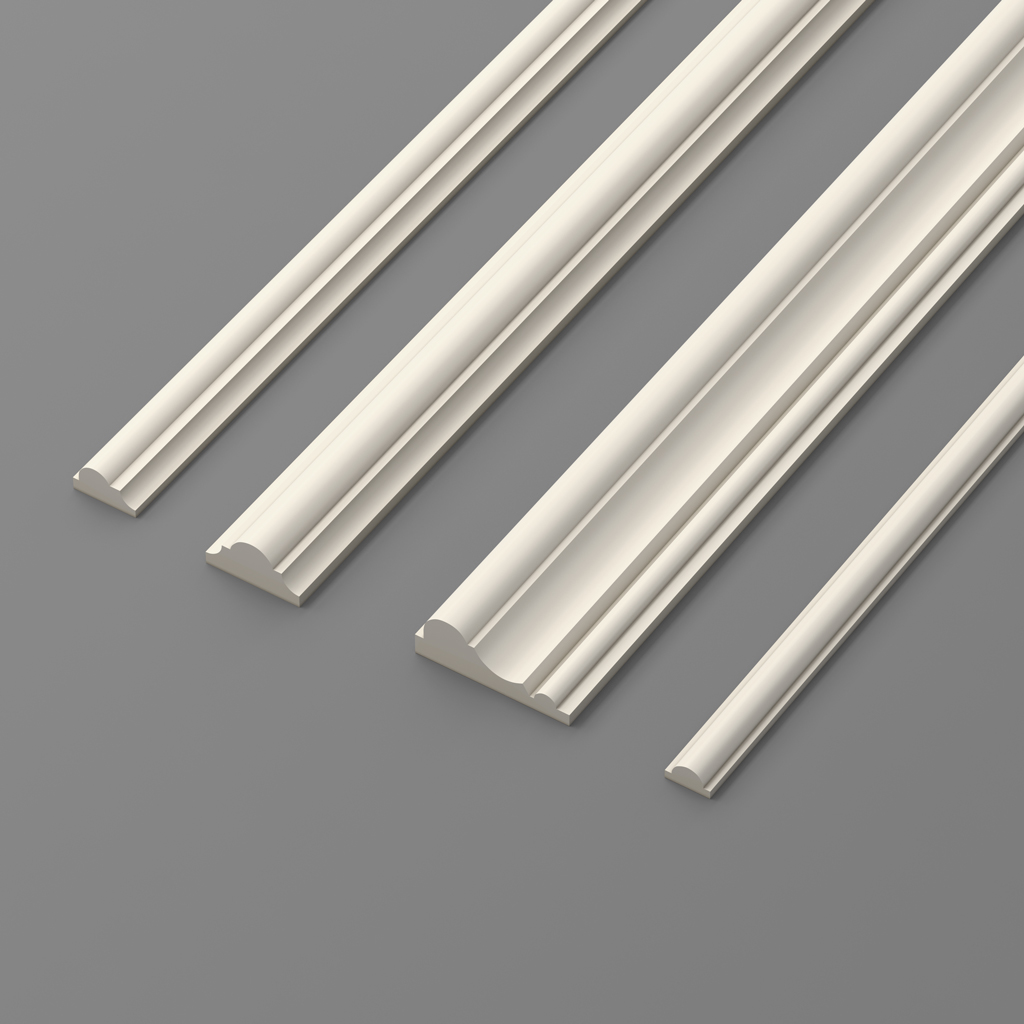
If a wall is a canvas, thenMoldings made of polyurethaneis the frame that turns the canvas into a painting. A molding is a narrow profiled strip that, when placed on a wall, creates visual boundaries, structures space, and transforms a plane into an architectural element.
History of moldings: from stone to polymers
Moldings have existed for thousands of years. In ancient temples, they separated architectural orders, emphasizing horizontals and verticals. In medieval castles, wooden moldings divided stone walls into panels. In Baroque-era palaces, plaster moldings created luxurious frames for paintings and gilding.
Traditionally, moldings were made from the same material as the main structure: stone for stone buildings, wood for wooden ones, plaster for plastered walls. This was expensive, labor-intensive, and required highly skilled craftsmen.
The 20th century brought new materials. First came polystyrene moldings—cheap but fragile, with poor detail. Then came polyurethane, a revolutionary material combining the lightness of plastic, the strength of rubber, and the ability to reproduce the finest relief details. Today, polyurethane moldings dominate interior decor, displacing plaster and challenging wood.
Creating frames: the basic technique of wall decor
The simplestuse of decorative elements—creating rectangular frames on the wall. Four molding strips forming a rectangle instantly turn a section of the wall into a panel. The inside of the panel can be the same material as the outside (just a solid color), but the frame itself already creates structure, emphasis, and completeness.
Frame proportions are critically important. The classic rule: the height of the panel relates to its width as 3:2 or 4:3. Too narrow vertical panels look nervous. Too wide horizontal ones look squat. Square panels are static but can work in symmetrical compositions.
Frame placement follows the logic of the wall. If the wall is solid, without openings, frames are positioned symmetrically relative to the central axis. If there are windows or doors, frames are centered relative to the openings. If the wall is long, frames are repeated at even intervals, creating rhythm.
Boiserie: French elegance of wall panels
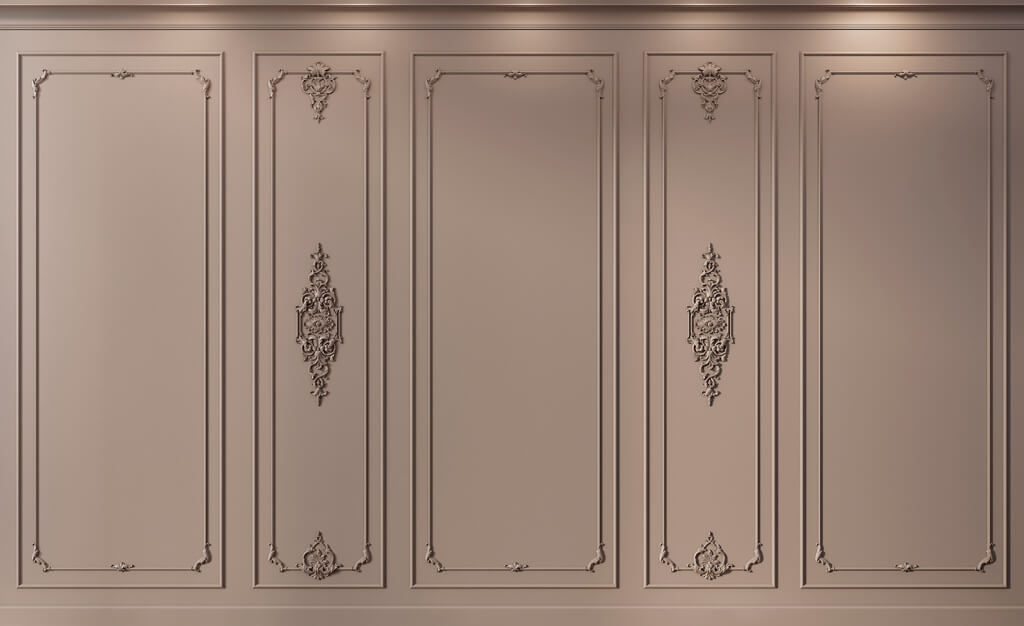
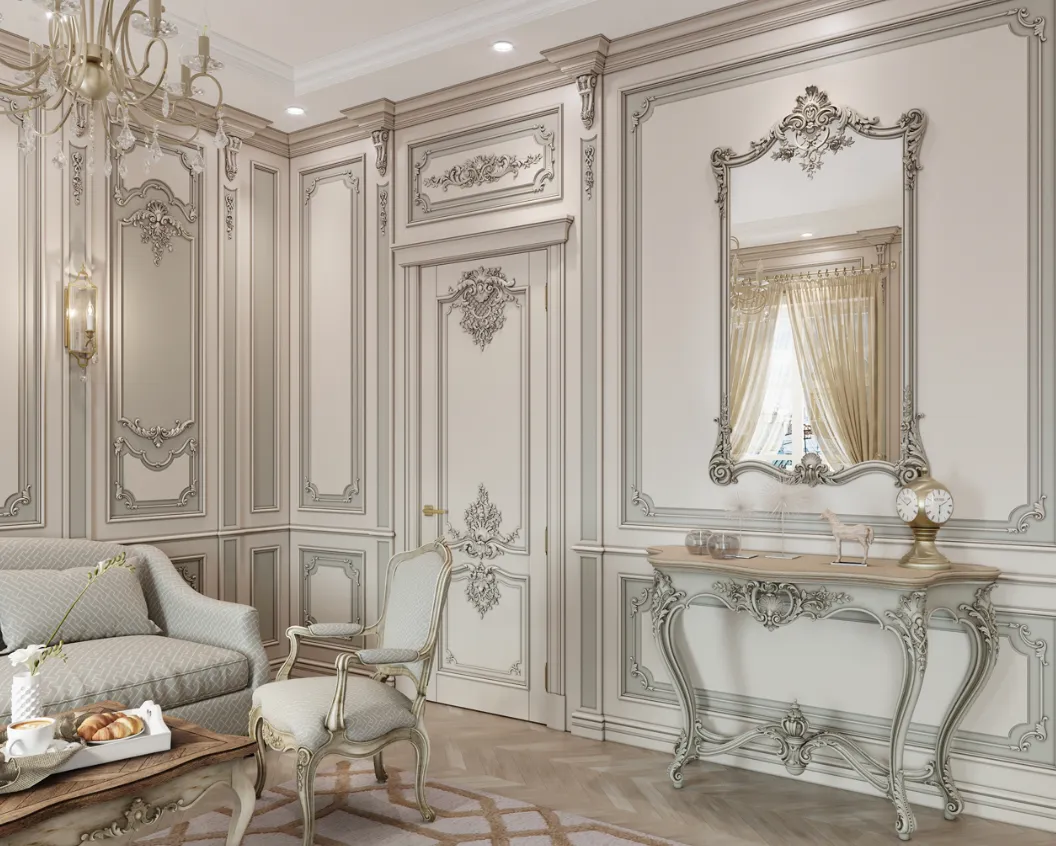
Boiserie is a French term for decorative wall finishing with wooden (originally) panels framed by moldings. Classic boiserie divides the wall into three zones: the lower zone (a panel 80-120 centimeters high from the floor), the middle zone (the main part of the wall), and the upper zone (a frieze under the ceiling).
The lower zone protects the wall from mechanical damage during furniture rearrangement, impacts, and wear. The middle zone is the main visual field, where large panels framed by moldings are placed. The upper zone is the transition to the ceiling, often with fine ornamentation.
Modern boiserie made from polyurethane moldings mimics this structure, but without massive wooden panels. The moldings create frames, inside which are wallpaper, paint, or decorative plaster. This achieves the visual effect of classic boiserie with minimal cost and load on the walls.
Molding Layout Schemes: The Mathematics of Beauty
There are time-tested schemes (maps) for molding placement that guarantee a harmonious result.
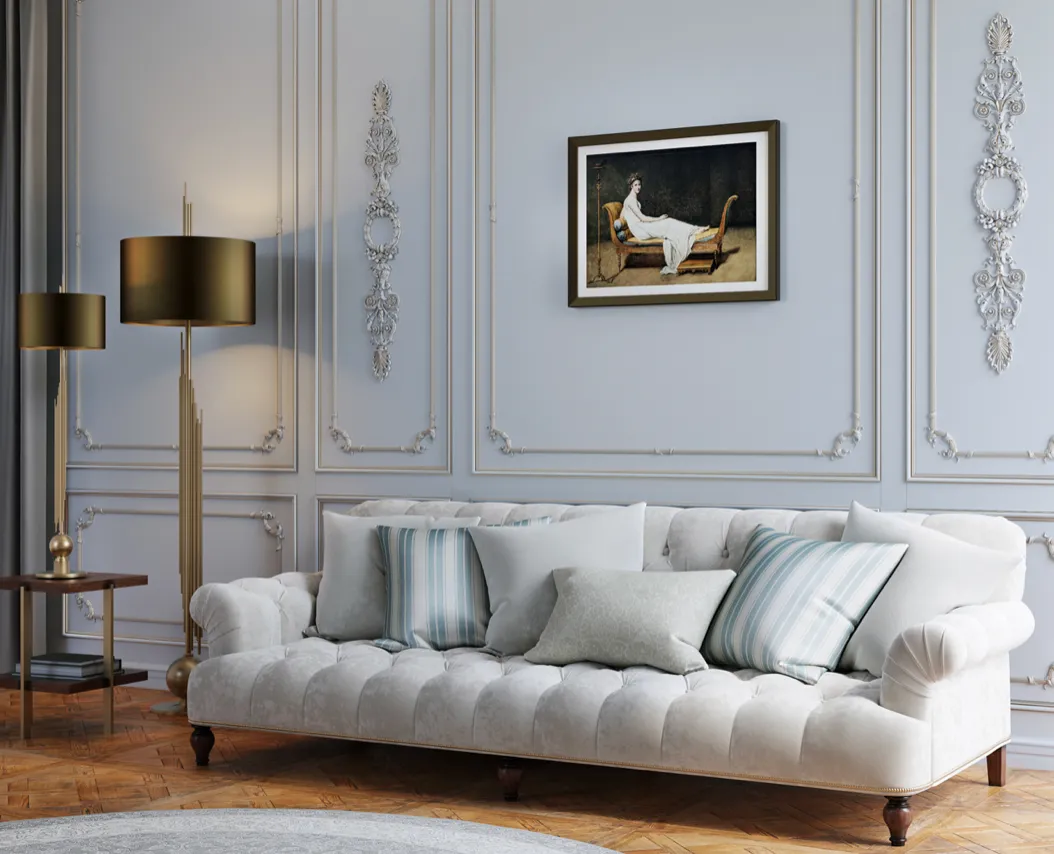
The 'One Large Panel' scheme creates one large frame on the wall, occupying 60-80% of the wall area. The margins from the edges of the wall are uniform (15-25 centimeters on each side). Suitable for accent walls in bedrooms (behind the headboard), living rooms (behind the sofa), dining rooms (behind the dining table).
The 'Three Vertical Panels' scheme divides the wall into three equal vertical zones, each framed with molding. Creates rhythm, visually raises the ceiling. Suitable for narrow, tall rooms, corridors, wall spaces between windows.
The 'Six Panels 3×2' scheme is classic boiserie. The wall is divided into two horizontal levels and three vertical zones, forming six panels. The lower level is often smaller than the upper one (1:1.5 or 1:2 in height). Suitable for formal rooms, studies, libraries.
The 'Frame within a Frame' scheme uses two concentric frames: a large outer one and a smaller inner one. Between them is a gap of 10-15 centimeters, often with a different color or texture. Creates depth, focuses attention. Suitable for highlighting a TV, fireplace, or painting.
The 'Rhythmic Row' scheme consists of many small panels of the same size, arranged with uniform spacing. Can be a horizontal row (panels elongated horizontally) or vertical. Creates dynamism, movement. Suitable for long corridors, galleries.
Installation Technology for Polyurethane Moldings
The process of installing moldings requires precision but is accessible for DIY execution.
Wall preparation — the surface must be level, clean, dry, and primed. Peeling paint or wallpaper is removed. Major unevenness is leveled with filler.
Marking — the contours of future frames are marked on the wall with a pencil. A long level or laser line builder is used for accuracy. Horizontal lines must be strictly horizontal, vertical lines — strictly vertical. Permissible deviation — no more than 1-2 millimeters per meter.
Cutting corners — moldings are cut at a 45-degree angle for joining at frame corners. A miter box (a device for precise cutting) or a miter saw is used. The cut must be perfectly smooth, without chips.
Gluing — polymer adhesive (liquid nails for polyurethane) is applied to the back of the molding in a zigzag or dotted pattern. The molding is pressed against the wall along the markings and held for 30-60 seconds until the adhesive sets. Excess adhesive is immediately removed with a damp sponge.
Sealing joints — after the adhesive sets (in 12-24 hours), the joints of the moldings are filled with white acrylic sealant. The sealant is smoothed with a finger or rubber spatula to create a smooth transition. The joint between the molding and the wall is also filled with a thin line of sealant.
Painting — after the sealant dries, the moldings are painted with water-based or acrylic paint in 2-3 coats. The color can match the wall color (moldings are only visible through relief) or be contrasting (classic option — white moldings on colored walls).
First mistake - unstructured mixing. A classic chair, loft table, Scandinavian chest, and minimalist cabinet in one room is not eclecticism, but visual chaos. Each item draws attention to itself, not creating cohesion. A system, logic, unifying idea is needed. Choose one dominant style, add a second as an addition, and possibly a third as an accent. But no more than three, and all should have something in common - color, material, era, or functionality.
Inaccurate marking — crooked lines, asymmetrical frames cannot be corrected after installation. Always double-check the marking before starting work.
Poor corner cutting — gaps in frame corners are glaring and ruin the entire job. Use a quality miter box or miter saw, and make test cuts on scraps.
Insufficient joint filling — if the sealant does not fill the gap completely, it will be visible even after painting.
Inappropriate molding scale — overly narrow moldings (20-30 mm) get lost on large walls, overly wide ones (80-100 mm) overwhelm small rooms. For a standard 15-20 m² room, moldings 40-60 mm wide are optimal.
Ignoring the style of the room—carved ornamental moldings look alien in a minimalist interior, just as simple smooth moldings do in a Baroque interior.
Wooden decor: warmth, texture, tradition
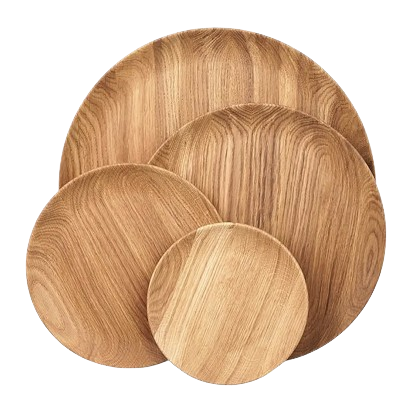
If polyurethane is technology and versatility, thenWoodis soul, warmth, connection with nature. Wooden elements on walls create an atmosphere of coziness, eco-friendliness, stability. Each wood species has a unique texture, color, annual ring pattern—no two products are absolutely identical.
Carved overlays: small forms of great art
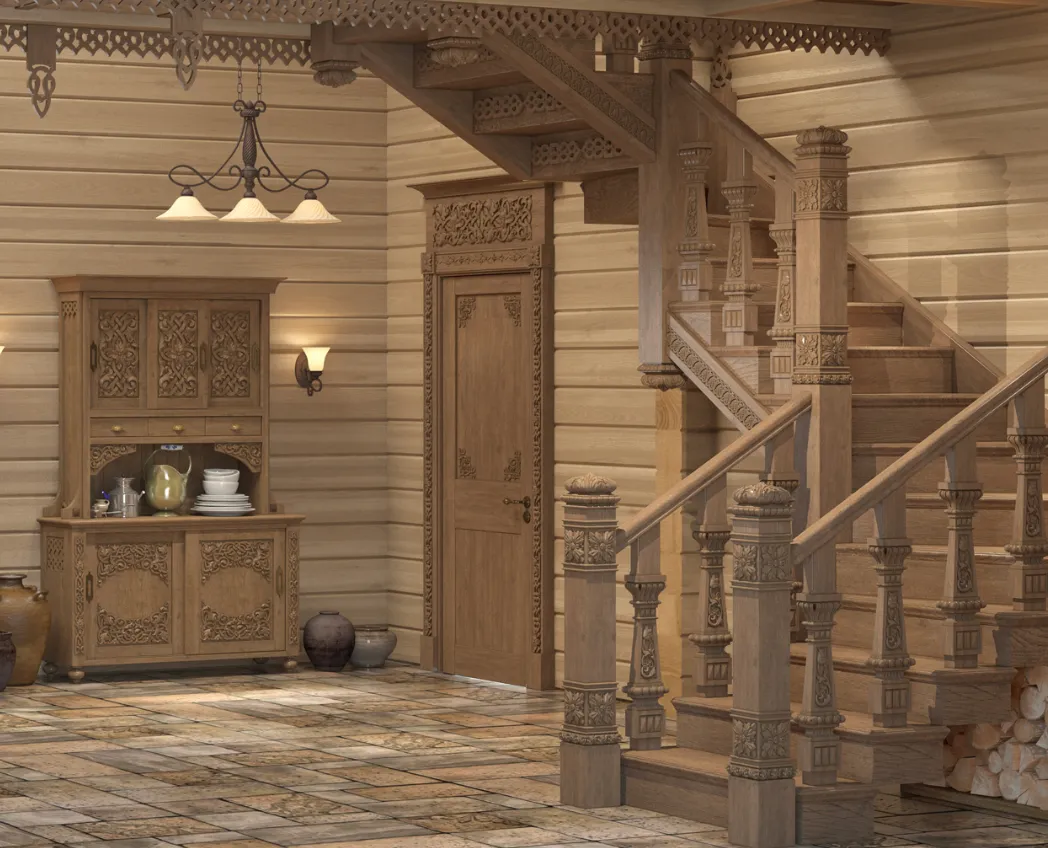
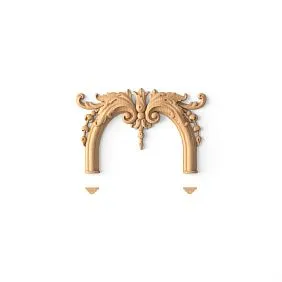
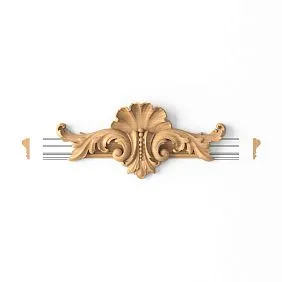
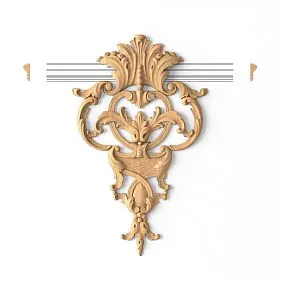
A carved wooden overlay is a small (from 5×5 to 50×50 centimeters) relief element with an ornament, which is applied to a flat surface of a wall, door, or furniture. Overlays are made from solid oak, beech, ash, or linden wood, either by hand or on CNC machines.
Ornaments of carved overlays are diverse:
Floral motifs—acanthus leaves, oak leaves, grapevines, flowers (roses, lilies, daisies), fruits. This is the most common group of ornaments, dating back to antiquity. Floral motifs symbolize life, fertility, prosperity.
Geometric patterns—rosettes (round symmetrical ornaments), diamonds, braids, meander (Greek pattern), guilloche (interlaced ribbons). Geometry creates a sense of order, rationality, mathematical beauty.
Figurative elements—mascarons (faces of people or mythological creatures), putti (infant angels), animals (lions, eagles, dragons), shields, coats of arms. Figurative overlays are accents, focal points, carriers of symbolic meaning.
The placement of overlays on the wall follows compositional logic. A single large overlay (30×40 cm or more) is placed in the center of the panel, above the door, on the fireplace portal — where an accent is needed. A pair of symmetrical overlays is placed on the sides of the central element (mirror, painting, fireplace). Multiple small overlays (5×5, 10×10 cm) are placed in the corners of panels, at the intersections of moldings, creating a rhythmic pattern.
Rosettes: Circular Perfection
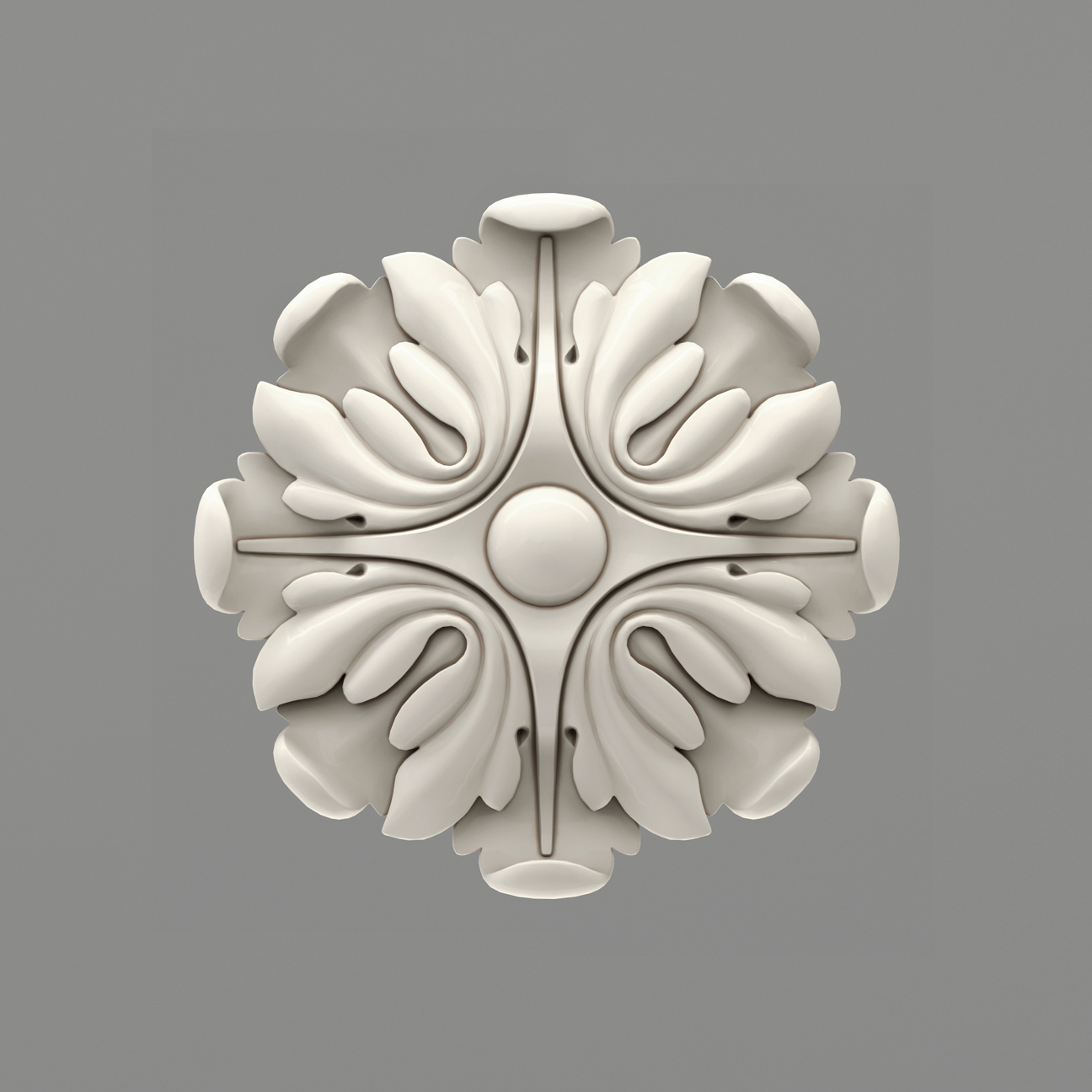
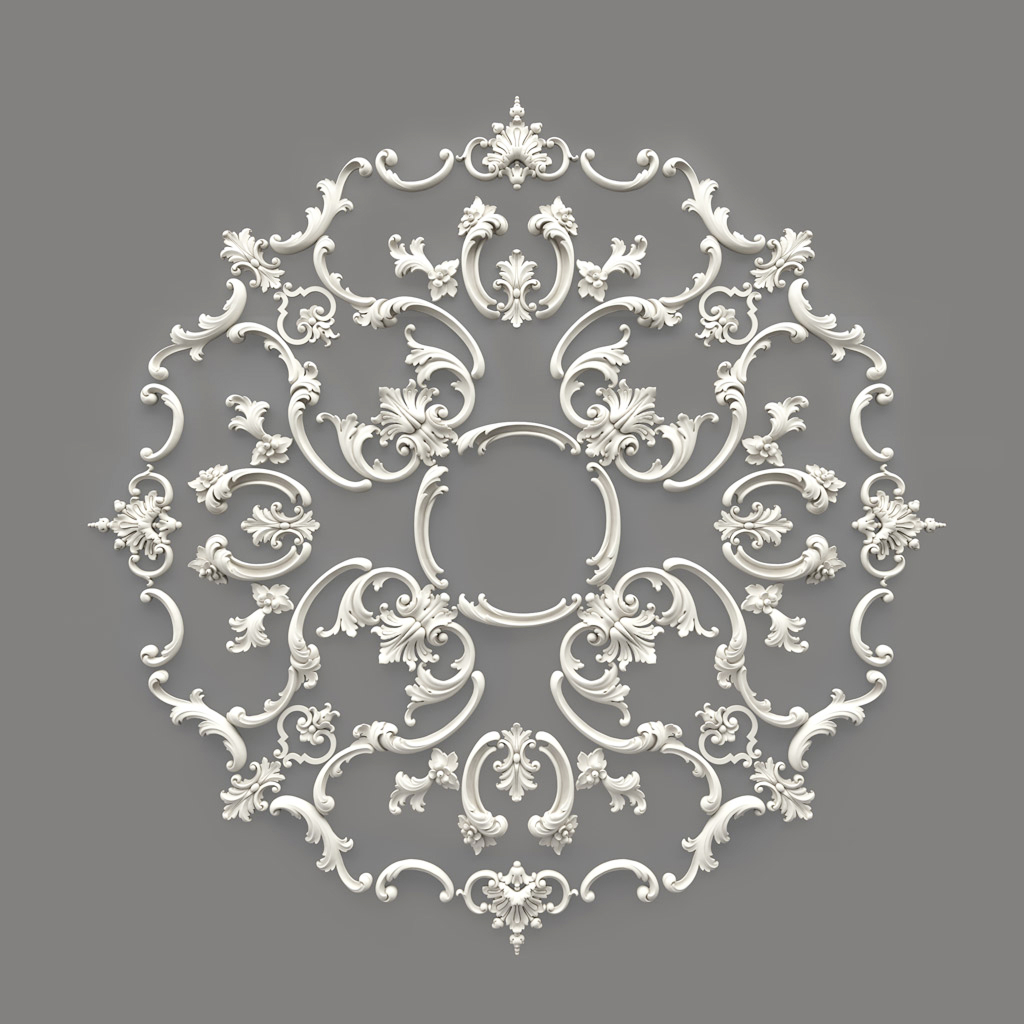
A rosette is a round or polygonal relief overlay with a symmetrical ornament radiating from the center. Rosettes have existed in interior decor for millennia — from Egyptian lotuses to Gothic rose windows.
Wooden rosettes on walls serve several functions:
Centering the composition — a rosette placed in the center of a panel creates a focal point from which the entire rest of the composition is built.
Accenting corners — small rosettes in the corners of panels soften geometricity and add ornamentation.
Concealing fasteners — rosettes were historically placed at the attachment points of chandeliers, sconces, paintings, hiding mounting elements.
The diameter of wall rosettes varies from 5 to 40 centimeters. The choice depends on the scale of the room and panels. For panels sized 80×120 cm, a rosette with a diameter of 15-20 cm in the center is optimal. For corner accents, 5-8 cm is sufficient.
Wooden Slats: A Modern Accent Wall
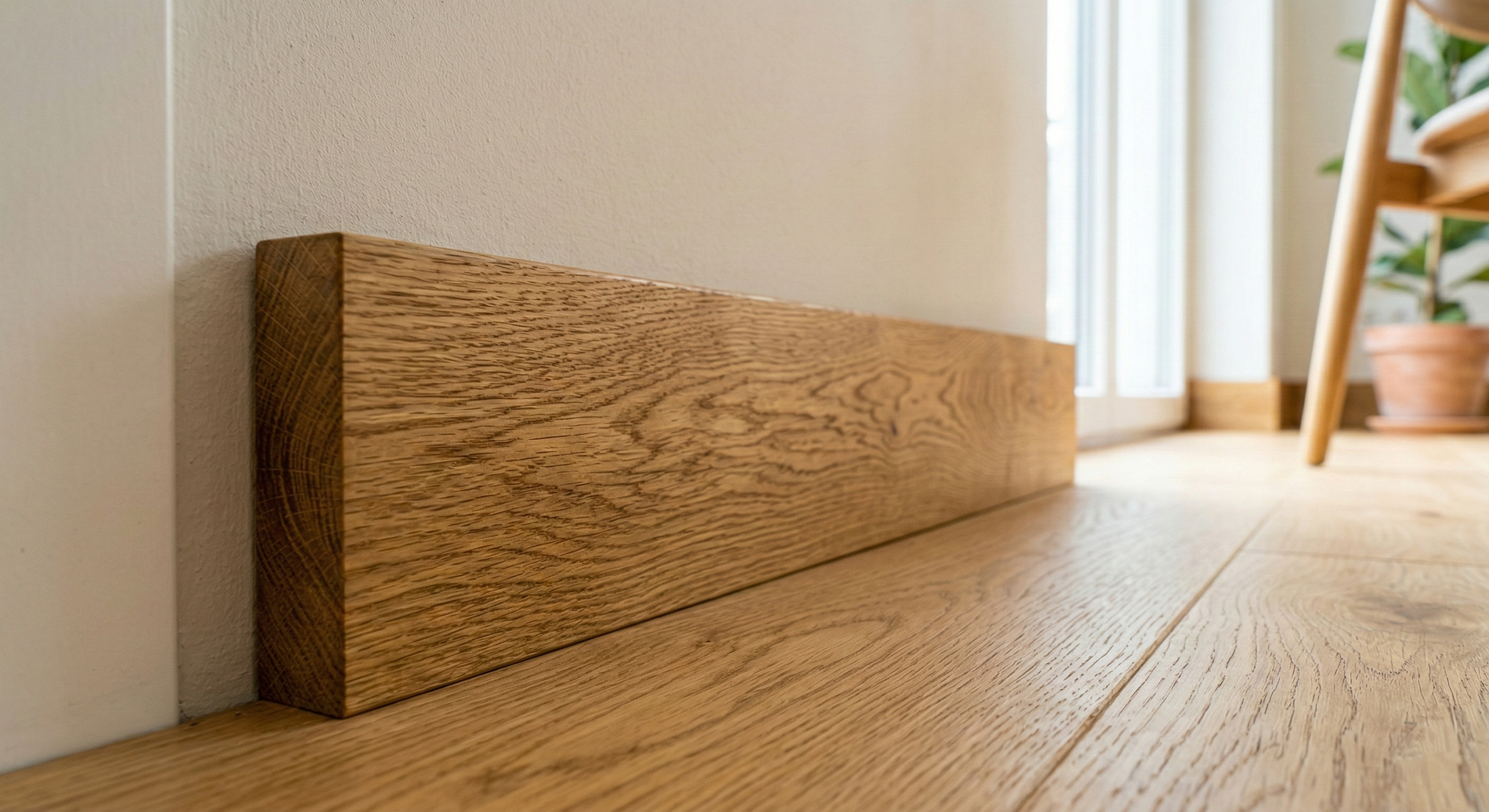
A wooden slat is a long, narrow strip of rectangular cross-section, attached to the wall vertically or horizontally. Slats create linear texture, rhythm, and depth. This is a modern alternative to classic moldings, popular in Scandinavian, eco, and loft interiors.
Typical batten cross-sections: 20×40 mm, 30×50 mm, 40×60 mm. Length — from floor to ceiling (2.5-3.5 meters) or fragmentary (1-2 meters, creating an accent zone). Spacing between battens (distance from the center of one to the center of the next) is usually 10-20 cm. Narrow spacing (10 cm) creates a dense texture, an almost solid surface with thin gaps. Wide spacing (20 cm) creates a clear rhythm of verticals or horizontals.
Vertical battens visually raise the ceiling, making the room appear taller. Horizontal ones — widen, make it appear broader. A combination of vertical and horizontal battens creates a grid, a geometric pattern.
There can be a contrasting background between the battens: dark battens on a light wall or vice versa. There can be lighting: an LED strip is placed behind the battens, light passes through the gaps, creating an effect of glowing lines.
Wood species for battens:
Oak — durable, with a pronounced texture, color from light to dark brown. Ideal for classic and loft interiors.
Ash — similar to oak, but lighter, with a softer texture. Good for Scandinavian interiors.
Beech — uniform, without a bright texture, pinkish hue. Suitable for painting in any colors.
Pine — affordable, light, with pronounced knots (if not select grade). For eco and rustic styles.
Batten processing: sanding, coating with oil (emphasizes texture, preserves matte finish) or varnish (creates shine, protection), possible tinting with stain or painting with enamel.
Mounting wooden decor on walls
Wooden elements are heavier than polyurethane ones and require reliable fastening.
For overlays and rosettes — two-component adhesive (epoxy or polyurethane) is used + secured with screws. The adhesive is applied to the back side, the overlay is pressed against the wall, and additionally fixed with 2-4 screws (depending on size). The screws are screwed into pre-drilled holes, countersunk, filled with wood putty to match the color, and sanded.
For slats — two installation methods:
-
Adhesive — slats are glued directly onto a flat wall using polyurethane mounting adhesive. Fast, but requires a perfectly flat wall.
-
Framing — a frame of horizontal battens (for vertical slats) or vertical battens (for horizontal slats) is mounted on the wall, then the slats are attached to the frame with screws or finishing nails. Allows for leveling wall irregularities, creating a ventilation gap, and placing lighting or sound-absorbing material behind the slats.
Wood protection — mandatory for durability. Even indoors, wood is subject to humidity fluctuations, dust settling, and hand contact. Minimum protection — coating with oil or wax (1-2 layers), which penetrates the structure and protects from within. Maximum — coating with varnish (2-3 layers), creating a surface film.
Using decorative elements: composition schemes
The beauty of decor depends not only on the quality of the elements but also on their arrangement. Composition is the rules by which elements interact, creating harmony or dissonance.
Symmetry: classical harmony
Symmetry is a fundamental principle of classical interiors. A symmetrical composition has a central axis, relative to which the left and right parts are mirror repetitions.
Symmetry on the wall is achieved through:
-
A central element (large overlay, rosette, painting) on the axis of symmetry
-
Paired elements on the left and right (two panels, two pilasters, two overlays)
-
Equal distances from the axis to the paired elements
Symmetry creates a sense of stability, solemnity, and formality. It is ideal for formal rooms: living rooms, dining rooms, studies. Symmetry also works in bedrooms: a bed centered on the wall, symmetrical panels on the sides, nightstands with sconces, mirroring left and right.
Asymmetry: modern dynamics
Asymmetry breaks mirror repetition, creating dynamics, movement, and surprise. Elements of different sizes, different weights, placed asymmetrically but balanced by visual mass.
Example of an asymmetrical composition on a wall:
-
To the left of center — a large panel 100×150 cm with a carved overlay inside
-
To the right of center — two smaller panels 60×100 cm, placed one above the other
-
The overall visual mass of the left and right parts is approximately equal, but the shapes are different.
Asymmetry is more difficult to execute—it requires a sense of balance and visual intuition. But the result is more modern, lively, interesting. Asymmetry suits creative spaces, youth interiors, lofts, and eclectic styles.
Rhythm: repetition and variation
Rhythm is created by repeating identical or similar elements at equal or varying intervals.
Uniform rhythm—elements are identical, intervals are identical. Example: five vertical panels on a wall, each 50×150 cm, with a 20 cm interval between them. Creates calm, order, predictability.
Progressive rhythm—elements or intervals gradually change. Example: panels decreasing from left to right (100 cm, 80 cm, 60 cm, 40 cm) or intervals increasing (10 cm, 15 cm, 20 cm, 25 cm). Creates movement, directionality, acceleration or deceleration.
Alternating rhythm—elements of two types alternate. Example: narrow panel—wide—narrow—wide. Or overlay—socket—overlay—socket. Creates variety, avoids monotony.
Rhythm is especially important on long walls (corridors, galleries), where uniformity quickly tires the eye.
Accents: focal points
An accent is an element that attracts attention, dominating the composition. On a wall, an accent is created through:
-
Size (a large overlay among small ones)
-
Color (a contrasting element on a plain background)
-
Position (central, on the axis of symmetry)
-
Complexity (a carved ornamental overlay among simple panels)
Rule: there should be one main accent in a composition. Two equal accents compete for attention, creating visual tension. One main + several secondary — works.
Proportions: golden ratio and simple fractions
Harmonious compositions are often based on mathematical proportions.
Golden ratio (1:1.618) — a proportion found in nature, perceived as the most harmonious. If a panel has a height of 100 cm, its width according to the golden ratio is 61.8 cm (or vice versa: width 100, height 161.8).
Simple fractions (1:2, 2:3, 3:4, 3:5) — also create harmony. A 60×90 cm panel (2:3 proportion) looks balanced. Square panels (1:1) are static, work in symmetrical compositions.
Modular system — a base module (e.g., 30 cm) is multiplied to create different elements: overlay 30×30 cm, small panel 30×60 cm, medium 60×90 cm, large 90×120 cm. All dimensions are multiples of the base module, creating visual unity.
Modern aesthetics versus classical canons
decorative elements style— is not an absolute concept. What adorns a classical interior can ruin a modern one, and vice versa. Understanding stylistic features is critical for successful decor application.
Classical interiors: abundance and ornament
Classical style (including Baroque, Rococo, Classicism, Neoclassicism, Empire) is characterized by an abundance of decorative elements. Walls are not just a background—they are works of art in themselves.
Typical features of classical wall decor:
Multiple panels—the wall is completely divided by moldings into panels of different sizes. Lower panel zone (80-120 cm from the floor), middle (main part), upper (frieze under the ceiling).
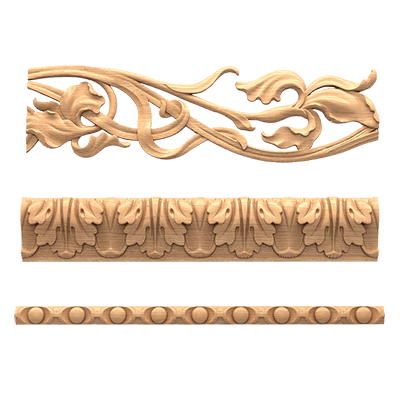
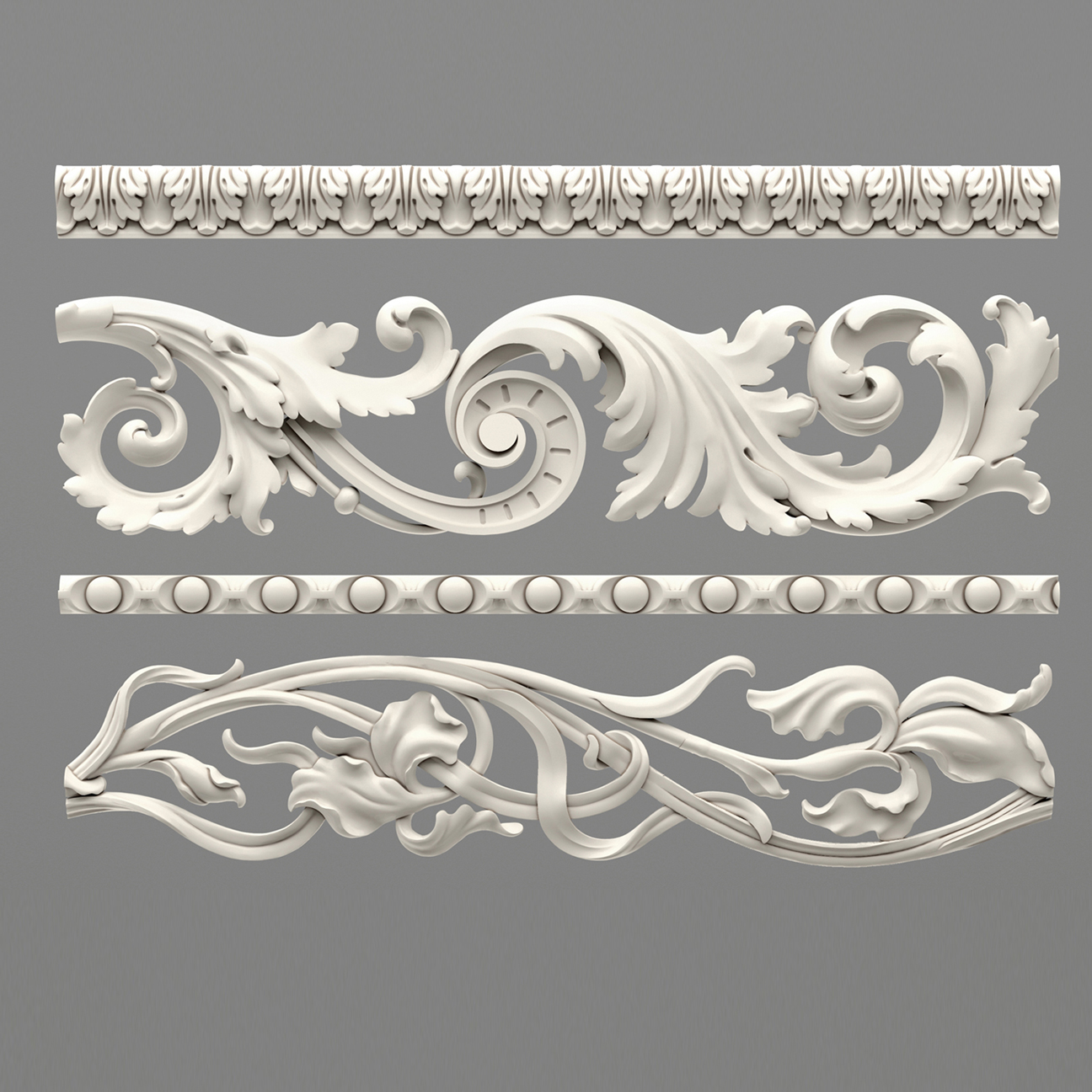
Ornamented moldings—not simple profiles, but carved ones, with plant motifs, egg-shaped ornaments (ovolos), pearl beading, meanders.
Carved overlays and rosettes—in panel centers, corners, above doors. Ornaments are complex, detailed, often gilded or patinated.
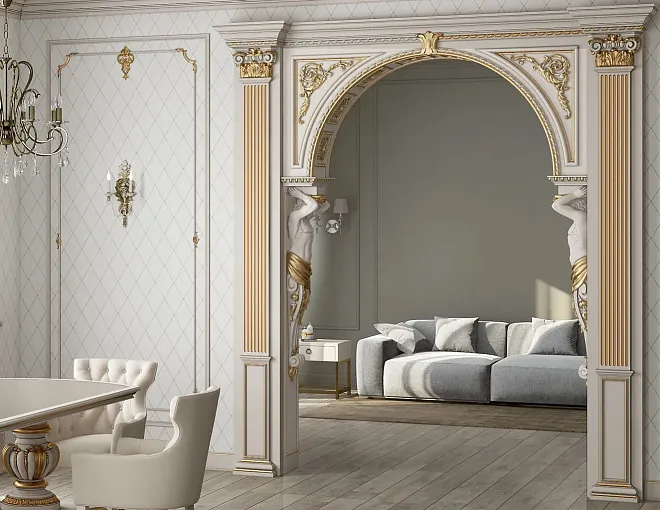
Pilasters—vertical elements imitating flat columns, dividing the wall. Consist of base, shaft, and capital.
Contrasting colors—white or light moldings and overlays on rich colored walls (burgundy, emerald, sapphire) or gilded elements.
Symmetry is a mandatory requirement. All elements are paired, mirroring each other relative to the central axis.
The psychology of classical decor: a demonstration of wealth, status, taste. The more details, the higher the craftsmanship, the more expensive. A classical interior should impress and command respect.
Modern interiors: minimalism and accents
Modern style (minimalism, Scandinavian, loft, contemporary) strives for simplification, clean lines, and functionality. Decor is present but dosed, strictly functional, or creates an accent.
Typical features of modern wall decor:
Minimum elements — not multiple panels, but one or two accent zones. The remaining walls are smooth.
Simple forms — moldings without ornament, straight profiles, geometricity. Overlays are geometric or completely absent.
Monochrome — elements in the color of the walls, revealed only by the shadow from the relief. Or a subtle contrast (light gray on white).
Asymmetry — allowed and welcomed. The accent panel is offset from the center, elements are of different sizes.
Natural materials — wood in its natural state (not painted, not gilded), with visible texture. Wooden slats are a characteristic element.
Accent wall — one wall is decorated (with slats, panels, overlays), the other three remain smooth. Creates a focal point without overloading the space.
Psychology of modern decor: mindfulness, focus on the essential, rejection of excess. Every element must be justified functionally or as a deliberate accent.
Transitional styles: neoclassicism and fusion
Between strict classicism and radical minimalism lies the space of transitional styles.
Neoclassicism — simplified classicism. The structure (panels, moldings, symmetry) is preserved, but ornamentation is minimal. Moldings are simple, without carving. Overlays, if present, are restrained, geometric. Colors are neutral (white, beige, gray). The result is the elegance of classicism without its pomp.
Fusion — mixing elements of different styles. Classical moldings + modern furniture. Carved wooden overlays + minimalist smooth wall. Balance is key: not a mechanical mix, but a thoughtful composition where the contrast of styles creates intrigue.
Eclecticism — an even freer mixing. Elements of three or four styles, different eras, different cultures can be combined. The main thing is visual unity through color, scale, or repeating forms.
How to choose your style
Style is determined not by fashion, but by lifestyle, values, and the character of the owner.
Do you value tradition, history, classical culture? Do you feel comfortable in a formal setting? Do you want the interior to inspire respect, demonstrate taste and prosperity? — The classic style is your choice. Use an abundance of moldings, panels, carved overlays, symmetry.
Do you value simplicity, functionality, free space? Do you feel uncomfortable among many details? Do you want an interior as a backdrop for life, not as a self-contained work of art? — Modern style is your choice. Use minimal decor, simple forms, accent zones.
Can't choose between classic and contemporary? Do you like both? — Neoclassical or fusion is your choice. Combine elements, seek balance.
Practical tips: ideas and implementation
Theory without practice is dead. Let's move on to specific ideas and recommendations.
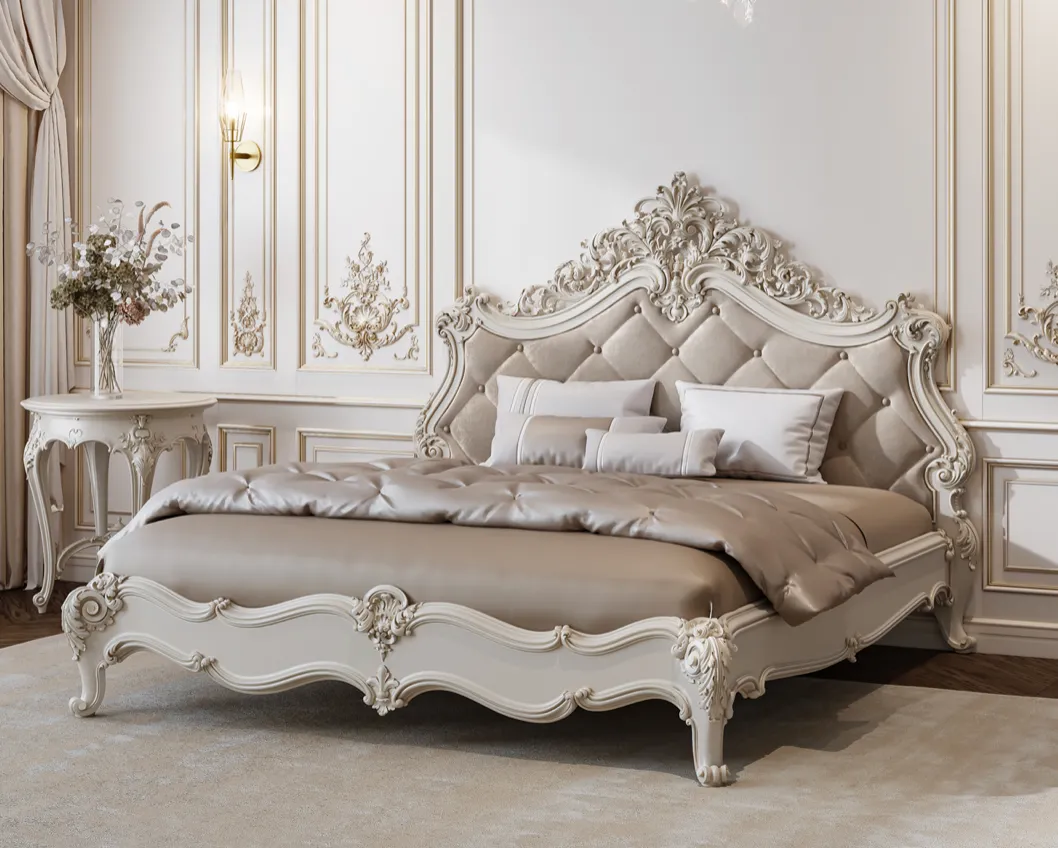
Idea 1: Accent wall behind the bed headboard
Task: Highlight the sleeping area, create a focal point, add elegance.
Solution: On the wall behind the bed, create one large panel made of moldings, occupying a space 20-30 cm wider than the bed on each side, with a height from the floor to 200-220 cm. Inside the panel — wallpaper with texture (silk, velvet) or decorative plaster of a contrasting color. In the center of the panel, at a level of 180 cm from the floor — a carved wooden rosette with a diameter of 20-25 cm.
Materials: Polyurethane moldings 50-60 mm wide, simple profile or with a small ornament. Carved rosette made of oak or beech, ornament — floral (leaves, flowers). Wallpaper — textured, solid-colored, 2-3 tones darker or lighter than the main wall color.
Effect: The bed becomes the center of the room, the focal point. The panel creates a sense of security, intimacy. The carved rosette adds sophistication, individuality.
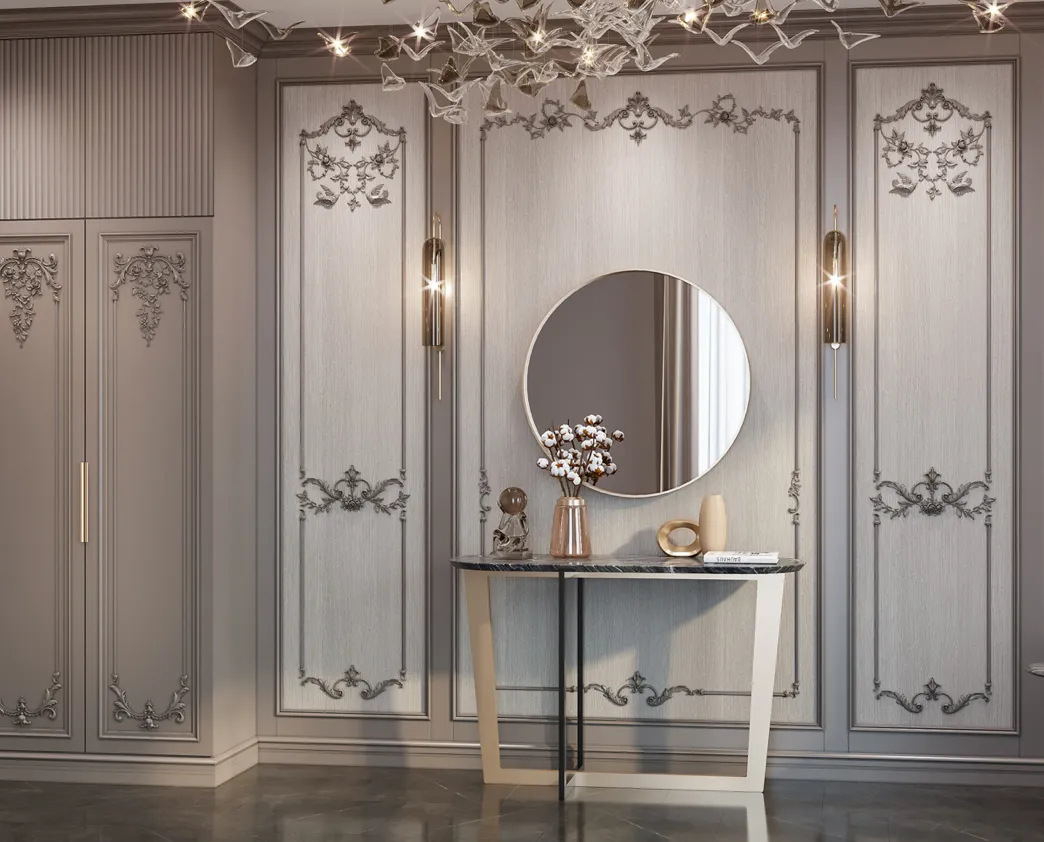
Idea 2: Gallery of panels in the corridor
Problem: A long narrow corridor is boring and lacks visual interest.
Solution: Create 4-6 vertical panels using moldings on one wall of the corridor, spaced evenly. The panels are narrow (40-50 cm) and vertically elongated (height 150-180 cm). Inside the panels—use either contrasting paint or black-and-white photos/graphics in frames, secured within the molding frames.
Materials: Polyurethane moldings 30-40 mm wide, simple profile. Matte paint, 3-4 shades darker than the walls.
Effect: The corridor stops being a mere passage tunnel and becomes a gallery. The rhythm of the panels creates movement, guiding the eye along the corridor. The verticality of the panels visually raises the ceiling.
Idea 3: Slatted accent wall in the living room
Problem: A modern interior needs texture, naturalness, and an accent behind the TV.
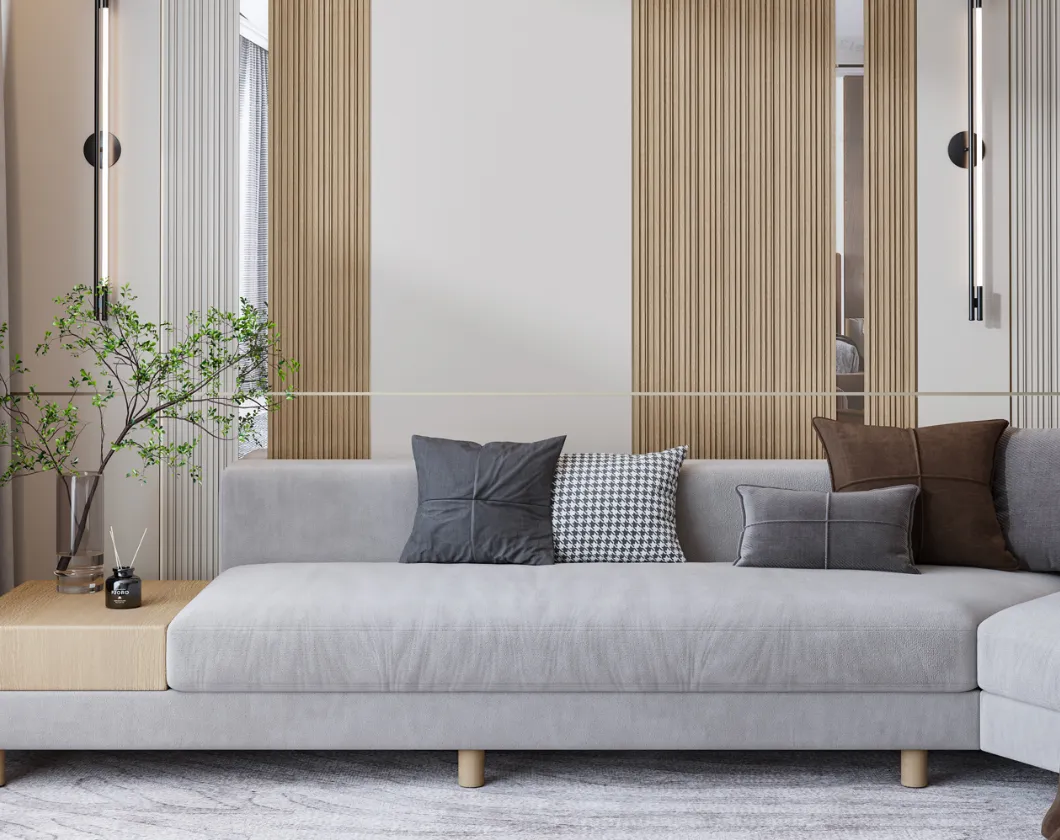
Solution: The wall behind the TV (or behind the sofa) is decorated with vertical wooden slats from floor to ceiling. The slats are oak, 30×50 mm in cross-section, spaced 15 cm apart (center-to-center). Between the slats—the wall is painted dark gray. The slats are coated with oil, natural oak color. Behind the slats, in the niches between them—LED strips create a glow through the gaps in the evening.
Materials: Wooden oak slats, wood oil (natural shade or slightly tinted). Warm white LED strip.
Effect: The wall becomes three-dimensional, textured, and alive. The wood adds warmth to the modern interior. The lighting creates a dramatic effect in the evening, softly highlighting the area.
Idea 4: Classic wainscoting in the study
Task: The office should look respectable, serious, and inspire trust.
Solution: All walls are divided into three zones. The lower zone (from the floor to 100 cm) — molding panels with dark green paint inside. The middle zone (from 100 to 230 cm) — three vertical panels on each wall, with wallpaper featuring a thin stripe inside. The upper zone (frieze under the ceiling, 20-30 cm) — narrow panels with gilded moldings. In the center of each middle panel — a carved overlay with a floral ornament, patinated to look antique.
Materials: Polyurethane moldings, two profiles — wide (70 mm) for main frames, narrow (40 mm) for details. Carved overlays made of beech, size 20×25 cm, ornament — oak leaves. Paints — dark green (RAL 6009), gold (acrylic paint with metallic sheen).
Effect: The office looks like in an English mansion of the 19th century. Seriousness, solidity, respectability. Clients, partners enter and see: a person of status works here.
Where to buy quality materials
The quality of decorative elements determines the durability and appearance of the result. Saving on materials results in additional costs for rework.
Polyurethane elements: Look for manufacturers that specify material density (at least 200 kg/m³), clarity of relief, presence of primer. Cheap elements made of expanded polystyrene (density 30-50 kg/m³) are fragile, with blurred relief, and quickly turn yellow.
Wooden elements: Solid wood, not MDF. Chamber drying (moisture 8-12%). Dimensional accuracy. Clarity of carving (if carved). Ability to choose wood species and treatment.
Comprehensive approach: It is better to buy all elements for the project from one manufacturer — this guarantees matching profiles, colors, and quality.
Frequently asked questions about wall decor
Can decorative elements be used on uneven walls?
Yes, but with caveats. Polyurethane moldings are flexible and can follow minor irregularities (up to 3-5 mm per meter). With significant unevenness, the moldings will bulge, and gaps will be visible underneath. Solutions: either level the walls before installation, use wide moldings (70-100 mm) that adhere better, or create not solid panels but separate frames on flat sections.
Wooden elements are rigid and do not bend. They require a flat base or installation on a frame that compensates for wall irregularities.
How much does wall decoration with moldings cost?
Depends on area, complexity, materials. Approximate prices (materials + labor):
-
Simple panel on a 3×2.5 m wall (one frame): 3000-5000 rubles
-
Boiserie on a 3×2.5 m wall (6-9 panels): 8000-15000 rubles
-
Slatted wall 3×2.5 m (wooden slats): 15000-25000 rubles
-
Full decoration of a 15 m² room (4 walls, complex boiserie, overlays): 50000-100000 rubles
Prices are approximate and depend on region, contractor, and chosen materials.
How long do decorative wall elements last?
Polyurethane moldings, when properly installed and painted, last 20-30 years without losing their appearance. Wooden elements with regular care (wiping, renewing the coating every 5-7 years) last 50-100 years. The limitation is not material wear, but changes in fashion or the desire to update the interior.
Can elements be removed without damaging the wall?
Polyurethane moldings glued with adhesive can be removed, but usually with damage to the wall's finish layer (paint, wallpaper). After removal, the wall will need to be patched, sanded, and repainted. Wooden elements attached with screws are easier to remove—the screws are unscrewed, leaving holes that are patched.
Are decorative elements suitable for wet areas?
Polyurethane is moisture-resistant and suitable for bathrooms and kitchens. However, high-quality painting with moisture-resistant paint and sealing of joints are required. Wood in wet areas is undesirable—it swells, warps, and develops mold. An exception is moisture-resistant wood species (larch, teak) with quality protective treatment.
How to choose the color of the elements?
Three strategies:
-
Matching the wall color—elements are painted the same color as the walls. They are only visible due to relief and shadow. Style: minimalism, modern.
-
Contrasting—classic: white elements on colored walls. Or vice versa: dark elements on light walls. Style: classic, neoclassical.
-
Natural wood color—wooden elements are not painted, but coated with oil/varnish, preserving the natural color and texture. Style: eco, Scandinavian, rustic.
Can polyurethane and wood be combined?
Yes, and it is often done. Polyurethane moldings (ceiling cornices, panel frames) + wooden overlays and rosettes inside panels. Polyurethane provides structure, wood provides accents, warmth, individuality. The main thing is stylistic unity: profiles and ornaments should harmonize.
Are special tools needed for installation?
For polyurethane moldings: a handsaw, a miter box (for cutting angles), a tape measure, a level, a pencil, glue, sealant, a spatula. All of this is available at any hardware store and costs 2000-3000 rubles.
For wooden slats: additionally — a screwdriver, screws, dowels (if attaching to concrete/brick), a laser level (desirable for precise marking of multiple slats).
Can a rented apartment be decorated?
Theoretically yes, but practically undesirable. Installing elements alters the walls (drilling, gluing), removal will require repairs. The landlord may require restoration to the original condition or compensation. Alternative: removable elements on double-sided tape (for light overlays), mobile slatted panels on a frame not attached to the wall.
Conclusion: walls as the canvas of your story
Walls are not just partitions separating a room from the outside world. They are canvases on which you tell your story. A story of taste, character, values, lifestyle. Smooth white walls speak of asceticism or temporariness. Walls adorned withdecorative elementsspeak of attention to detail, of a desire to create not just a functional space, but an atmosphere.
use of decorative elementson walls is an art that requires an understanding of composition, proportions, styles. But it is an accessible art. You don't need to be an architect or designer to create a beautiful wall. You need to study basic principles, look at examples, choose quality materials, and not rush the implementation.
Moldings made of polyurethaneWe democratized wall decor, making it accessible to everyone. What once required the work of expensive plastering masters can now be done independently over a weekend.Wooden decorationIt adds naturalness, warmth, individuality — something that is lacking in a world of plastic and concrete.
Choosingdecorative elements styleRemember: there is no right or wrong choice. There is only what aligns with your personality, your lifestyle. Classic style with an abundance of panels and carved overlays is for those who value tradition, stability, and showcasing taste. Minimalism with one accent wall is for those who value simplicity, functionality, and focus on the essentials. Fusion and eclecticism are for those who don't want to choose, who create their own rules.
Start small. One accent wall. One panel behind the bed. A few wooden slats in the living room. See how it changes the perception of the space. How it changes how you feel in that space. And if you like the effect — continue. Decorate other walls, other rooms. Experiment with shapes, colors, materials.
Interior design is not a one-time project, but a process. It grows and changes with you.Wall decor elements— is a tool for this process. A simple, accessible, powerful tool for turning a house into your personal world.
STAVROS: the workshop where details are born
When it comes to quality decorative elements, the name STAVROS sounds like a guarantee. For over two decades, the company has been creating details that turn ordinary interiors into works of art. Not mass-produced goods from faceless factories, but elements with character, crafted with attention to every millimeter.
STAVROS polyurethane molding isMoldingsfor walls in more than 100 profiles — from minimalist smooth planks to complex ornamented ones with botanical motifs. Width from 20 to 150 millimeters — a choice for any room scale. Material density of 200-280 kg/m³ ensures clarity of relief, strength, and durability. Each element is cast in molds made from handcrafted master models — this guarantees the detailing of every groove, every leaf of the ornament.
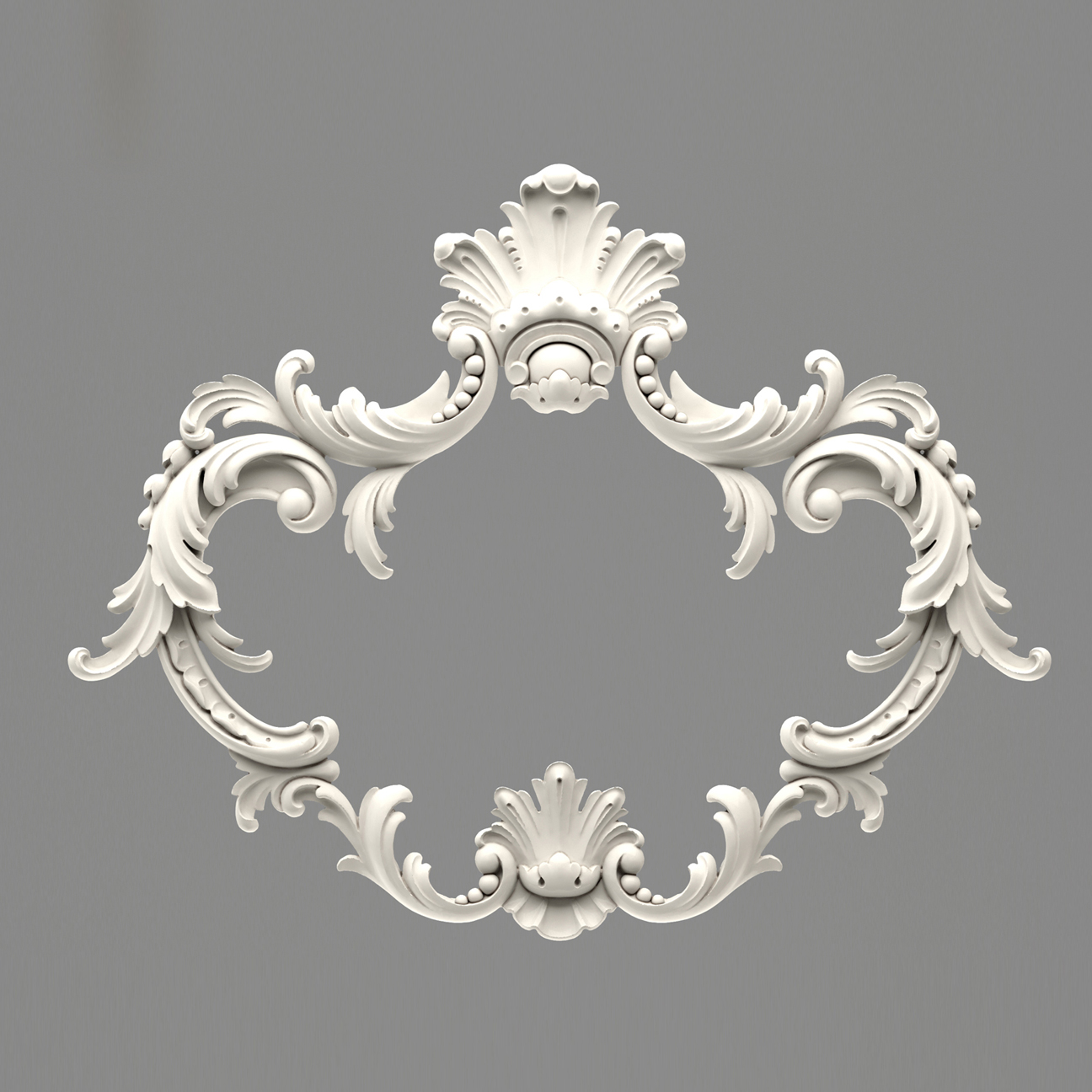
Ceiling and wall rosettes with diameters from 15 to 120 centimeters — for creating central focal points. Pilasters and half-columns — for vertical wall articulation. Corner elements — for completing compositions. The entire range is available in Moscow and St. Petersburg showrooms, where you can see, touch, and assess the quality in person.
STAVROS wooden elements are carved appliqués made from solid oak, beech, ash with ornaments ranging from classical floral to geometric. Sizes from miniature 5×5 cm to large panels 50×100 cm. Each overlay follows a journey from selected raw materials (chamber-dried to 8-12% moisture content) through milling on Morbidelli machines to manual finishing by master carvers. The result is detailing unattainable by purely mechanical means, liveliness of lines, and the individuality of each piece.
Wooden slats for accent walls — oak, ash, beech, larch — in cross-sections from 20×40 to 40×80 millimeters, up to 3 meters in length. The slats are supplied sanded, ready for finishing (oil, varnish, paint) or already treated in the chosen shade. Dimensional accuracy of ±0.5 millimeters guarantees that when installing multiple slats, they form a perfectly flat plane, without steps or warping.
Boiserie — wall panels made from solid wood or composite (MDF base + veneer of valuable species) — are manufactured according to individual projects. The STAVROS design team will develop a panel layout considering the room's geometry, style, and budget. They will create a 3D visualization where you can see the result before production begins. They will make adjustments based on your wishes. Then production will manufacture all elements — frames, panels, overlays, rosettes — in a unified style, with perfect color and texture matching. Installation crews will mount the panels with a quality guarantee.
Individual approach — the philosophy of STAVROS. There are no two identical projects, no template solutions. Each client is a unique task requiring an individual approach. Managers will listen to your wishes, assess the object's features, and propose optimal solutions. Designers will create sketches, visualizations, help choose elements, colors, materials. Technologists will adapt the project for production, calculate quantities, and timelines. Production will manufacture the elements with the precision and quality that have become the hallmark of STAVROS.
Comprehensive solutions — another advantage. STAVROS offers not just individual moldings or overlays, but ready-made solutions for entire rooms: all elements for decorating a living room, bedroom, study, calculated, selected, ready for installation. This saves your time, eliminates calculation errors, and guarantees stylistic unity of all elements.
Delivery geography — all of Russia and CIS countries. Logistics are established for careful delivery of even fragile carved elements. Partnership with transport companies ensures optimal delivery times and costs to any region.
Quality guarantee — all products undergo control at every stage: raw material acceptance, production, packaging. Defective elements do not reach the client. A warranty is provided for the products, confirming: if a manufacturing defect is discovered during the warranty period — the element will be replaced free of charge.
Experience and reputation — over the years, STAVROS has completed thousands of projects: from city apartments to country residences, from offices to restaurants and hotels. The portfolio includes both standard and unique objects. Client reviews are the best confirmation of quality: STAVROS elements last for decades, maintaining their original appearance, without requiring replacement or repair.
Create interiors whereWall decor elementsThey don't just decorate the space, they tell a story. Your story. A story of taste, character, individuality. Trust in quality, tested by time. Trust in craftsmanship, embodied in every detail. Trust STAVROS.