





















Article Contents:
- Why Furniture Legs Are Needed — Function and Design
- Three Roles Performed by Furniture Supports
- Why Wood Is the Best Material for Furniture Supports
- Types of Furniture Legs: Tapered, Turned, Square, Carved, Adjustable
- Tapered Legs: Scandinavian Classic and Midcentury Modern
- Turned Legs: Classic in All Its Glory
- Square (Block) Legs: Honesty of Material
- Legs with Threaded Mounting: Standard of Modern Hardware
- Height-adjustable legs: precision leveling
- Cabriole: a leg with history
- Wood species: oak, beech, birch — which to choose for a sofa and armchair
- Oak: the standard of reliability for load-bearing supports
- Beech: precision of form and affordability
- Birch: budget without compromising dignity
- Larch: support for high-humidity environments
- Ash: white and graphic
- Dimensions: height, diameter, mounting thread — how to measure
- Leg height: function and ergonomics
- Diameter and cross-section: load-bearing capacity calculation
- Mounting thread: M8, M10, M12
- How to correctly measure a leg for replacement
- How to replace legs on a sofa or dresser yourself
- Replacing sofa legs: faster than it seems
- Replacing legs on a dresser or side table
- Updating legs without replacement: painting and restoration
- Furniture supports in different interior styles
- How legs define furniture style
- Legs and floor: tactile and visual contact
- FAQ: Answers to Popular Questions
- About the Company STAVROS
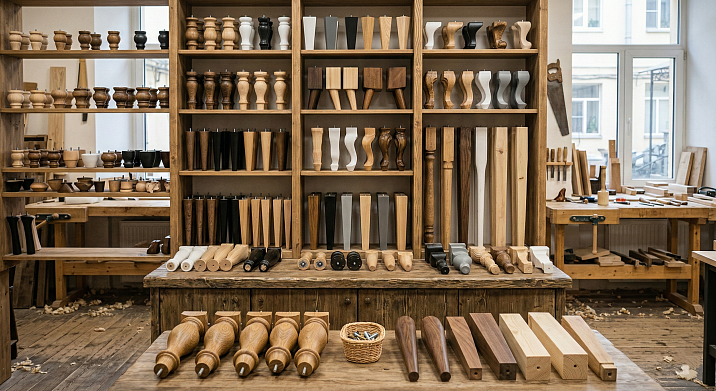
Look closely at any piece of furniture—not at the upholstery, not at the fronts, not at the color. Look down. It is there, a few centimeters from the floor, that what defines the character of the entire piece is hidden.furniture legsThese are not 'stands' or 'supports' in the technical sense. They are the architectural foundation of the piece, its plastic accent, its connection to the floor and space. A sofa on low conical legs looks modern and tense. The same sofa on high turned supports—elegant and free. The same body, the same upholstery—yet the feeling is completely different.
This is the magic that wooden furniture legs carry. And that is precisely why their choice deserves a separate conversation—thoughtful, detailed, with examples and specific data.


Why furniture legs are needed—function and design
The three roles performed by a furniture support
A furniture support is a multifunctional element. It has three roles, and all of them are equally important. Underestimating even one means getting furniture that is either unattractive, unreliable, or uncomfortable.
Structural function. Legs lift the furniture body above floor level and transfer the load from the furniture and its contents to the room's foundation. A wooden leg for an 80 kg sofa plus two people at 90 kg each is a total load of about 260 kg, distributed over four points. Each point carries 65 kg. With non-standard seating—when a person sits down abruptly on one edge—the load on one leg can briefly reach 120–150 kg. For a wooden support, this is a feasible task only with the right wood species and sufficient cross-section.
Spatial function. The gap between the furniture and the floor is not empty space. It is ventilation that protects the lower surface of the body from condensation and mold. It is access for cleaning: a vacuum cleaner can go under the sofa, a mop can reach under the bed. It is visual 'lightness'—the furniture does not lie on the floor like a heavy slab, but stands above it, creating a sense of space.
Design function. This is the most obvious and yet the most underestimated. The shape of the leg sets the stylistic code of the entire piece. A turned leg with a baluster speaks of classic style. A straight conical leg—of the 1950s, of Scandinavian style, of conciseness. A cabriole with a curve—of Baroque and chinoiserie. A rectangular block leg without profiling—of rough rustic or modern minimalism. Just one element defines the era, style, and mood of the entire item.
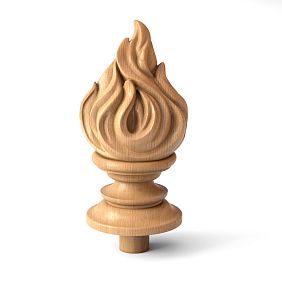
Our factory also produces:





Why wood is the best material for furniture supports
Metal legs, plastic supports, acrylic and glass constructions — each material has its own niche. But it is Furniture legs made of wood that take first place in terms of overall characteristics in most residential interiors. And here's why.
Wood is warm — not only physically (its thermal conductivity is 50–80 times lower than that of steel), but also visually. In a living space, this matters: metal legs on a sofa in the living room create a feeling of an 'industrial space,' while wooden ones create a feeling of 'home.'
Wood can be processed precisely. Turned, milled, carved wooden shapes hold details that cannot be reproduced in metal without industrial casting. It is wood that allows creating complex classical profiles — scrolls, balusters, acanthus motifs — in an affordable price range.
Wood is repairable. A scratch on a wooden leg can be removed by sanding and repainting. A dent in metal — cannot.
Finally, wood is durable. An oak leg, with proper use, lasts 30–50 years without losing its load-bearing properties.
Get Consultation
Types of furniture legs: tapered, turned, square, threaded, adjustable
Tapered legs: Scandic classic and midcentury modern
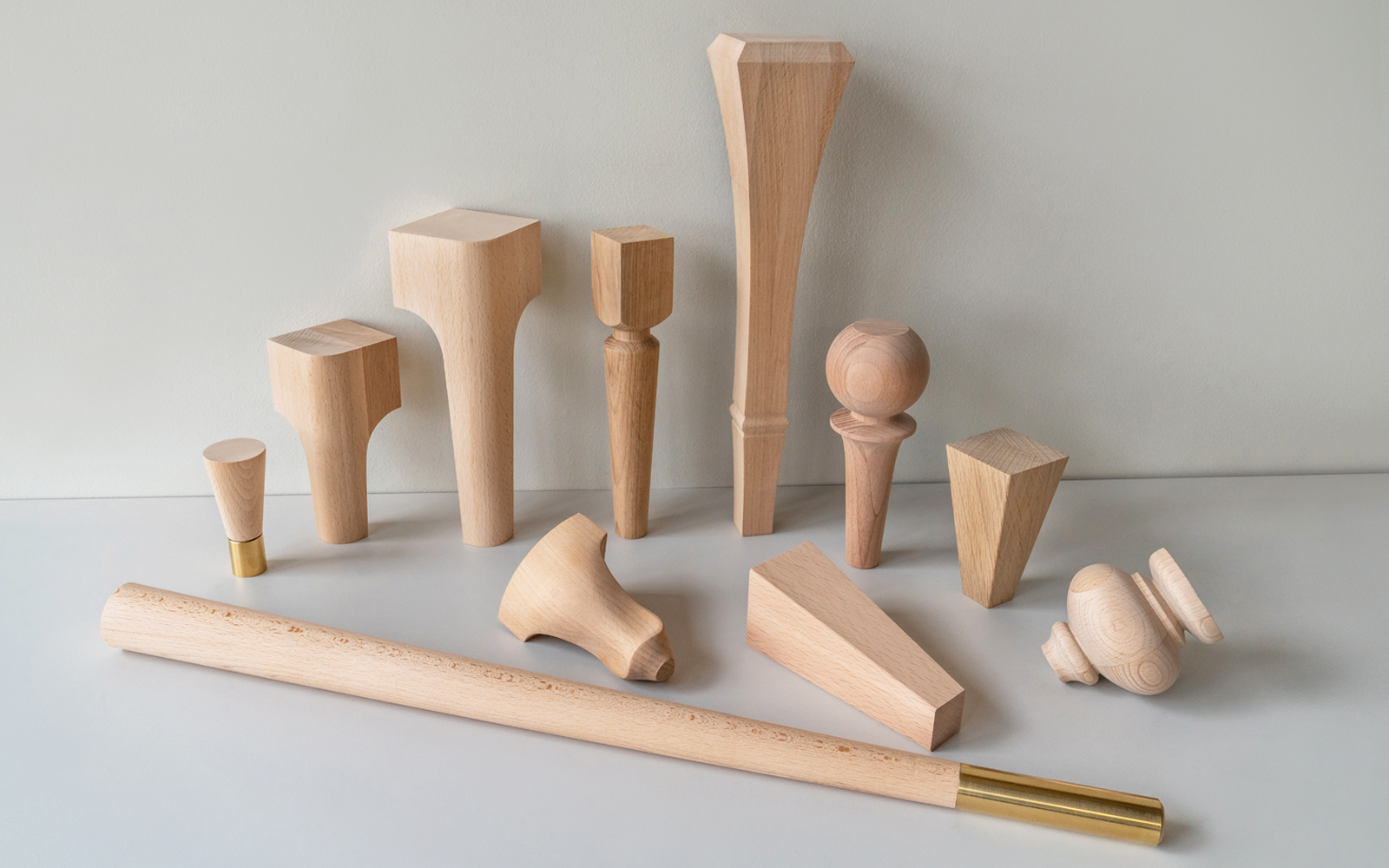
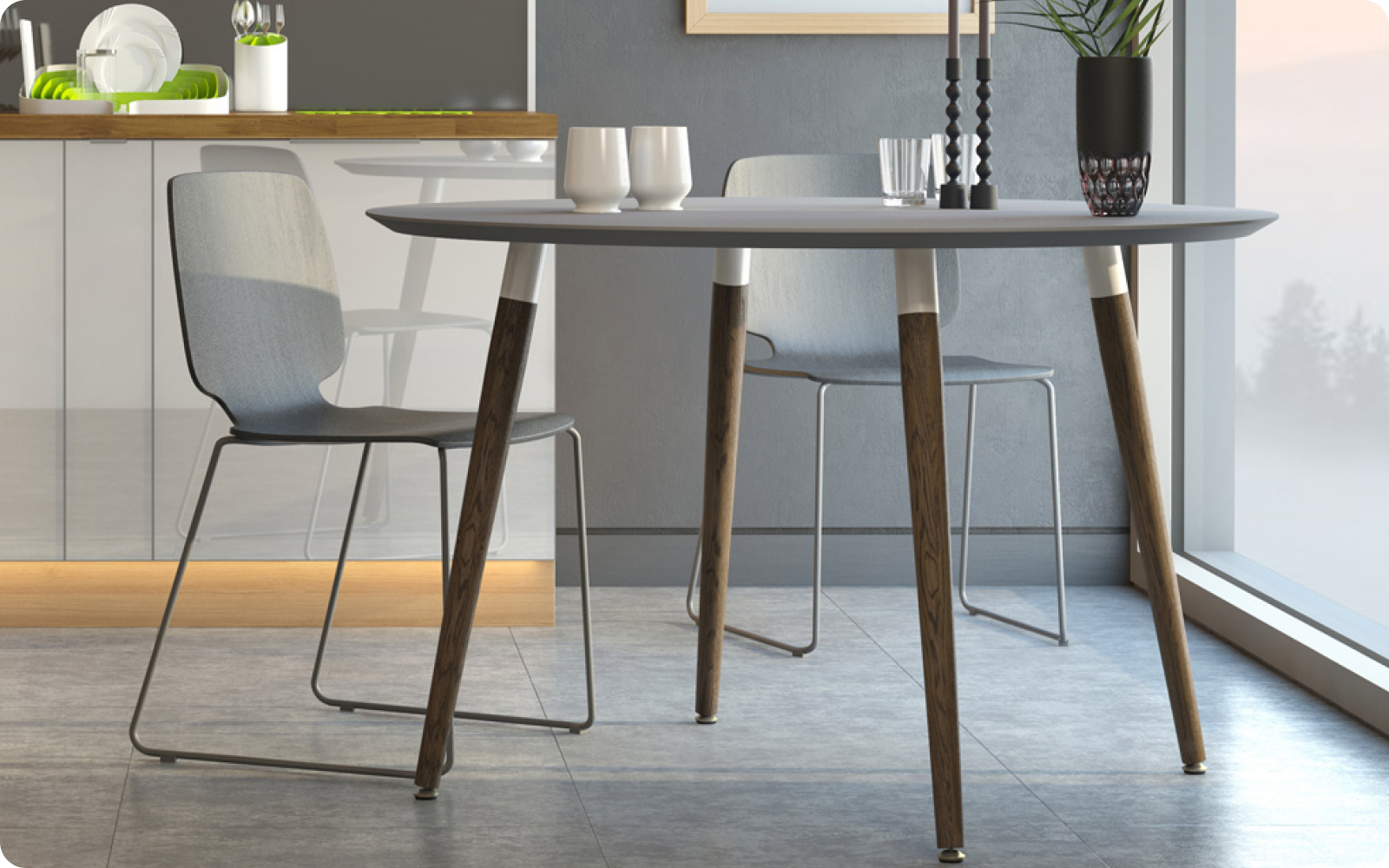
A tapered leg is a truncated cone: a square or round cross-section at the base of the furniture gradually narrows toward the floor. It emerged as a mass design element in the mid-20th century — during the era of Scandinavian functionalism and American midcentury modern — and has remained relevant ever since.
What makes the tapered shape attractive? It is both stable and laconic. The wide base provides reliable support, while the narrowing toward the bottom adds visual lightness. In an interior, a tapered leg is perceived as 'neutral' — it does not declare style as aggressively as turned or carved legs, yet it has character.
Conical wooden legs are available with square cross-section ('Scandinavian' – angular, strict) and with round cross-section ('soft' – smooth, retro). Height – from 60 to 250 mm. Diameter or width of base – from 35 to 80 mm. Fastening – M8 or M10 threaded stud, screwed into the top end of the leg.
Conical legs are organic on sofas and armchairs in Scandinavian, Japanese, minimalist styles. On coffee and side tables, conical supports made of oak or beech are one of the most popular options of the last decade.
Turned legs: classic in all its glory
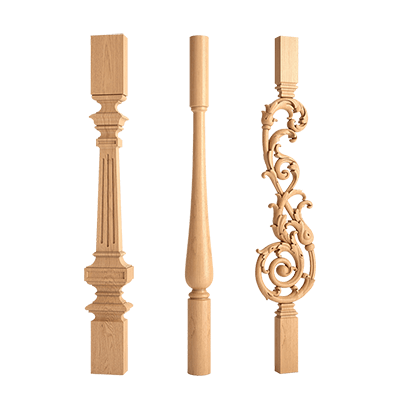
A turned leg is a profile created on a lathe: alternating thickenings, recesses, profile elements (balusters, vases, spools). This is the most richly shaped group of furniture supports, rooted in Renaissance woodworking tradition.
Varieties of turned legs:
Baluster – the central part of the leg has the shape of a baluster: an expansion in the center with two recesses. A classic form for furniture in Baroque style, Italian classic, English furniture of the 17th–18th centuries.
Spool – alternating cylinders and recesses, resembling a spool of thread. Less pompous than the baluster, suitable for interiors in Provence, country, 'rustic classic' style.
Vase – the lower third of the leg has the shape of an inverted vase. This is an element of furniture in the style of Louis XIV–XVI, antiques, classic study interiors.
Square turned – rectangular cross-section with profile elements on the faces. Often used in furniture in neoclassical, Empire style, for beds and chests of drawers.
turnedFurniture Supportsmade of oak with stain or patina – this is a solution that instantly 'raises' the class of any product. A bed without a headboard on turned dark oak legs looks like an atelier piece, not a store-bought one.
Square (block) legs: material honesty
A block leg is a straight rectangular parallelepiped without profiling. The simplest form and yet one of the most demanding in terms of design: there is no decoration to hide flaws—only material quality and manufacturing precision.
Block legs made of oak or ash with an open, coarse texture speak the language of both modern minimalism and rustic style. In a living room with a brick wall, live plants, and linen textiles, such legs on a sofa or dining table look absolutely organic.
Square supports are available in cross-sections from 40×40 to 80×80 mm and heights from 50 to 400 mm. For case furniture—chests of drawers, cabinets, wardrobes—low block legs of 50–80 mm are more commonly used: they lift the case without creating excessive height.
Legs with threaded fastening: the standard of modern hardware
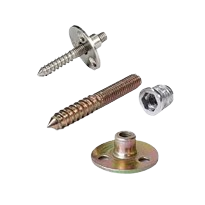
Most modern wooden legs for upholstered furniture—sofas, armchairs, poufs—are equipped with a metal threaded stud, glued or screwed into the top end of the leg. Standard thread sizes: M8 (8 mm diameter) and M10 (10 mm diameter). The length of the protruding stud is 20–30 mm.
Matching metal plates with threaded holes are installed in the base of the upholstered furniture—exactly for the leg's stud. Replacement procedure: unscrew the old leg counterclockwise, screw in the new one clockwise. Two minutes—and the furniture is transformed.
Important nuance: when purchasing new legs for replacement, it is necessary to precisely determine the type and pitch of the thread on the matching plate. The most common thread pitch for M8 is 1.25 mm. If the pitch does not match, the leg will either not screw in or will not hold securely.
Height-adjustable legs: precision leveling
For case furniture—kitchen units, sliding wardrobes, built-in elements—furniture leveling legs are used. These are metal or plastic supports with the ability to change the height by 10–50 mm by rotating a threaded rod.
In wooden legs, adjustment is implemented differently: a metal nut is glued into the lower part of the leg, into which an adjustment bolt is screwed. This design combines the aesthetics of natural wood with the technical function of leveling—especially in demand on uneven bases.
For kitchen sets, the standard is adjustable supports 100–150 mm high, which are covered with decorative plinths. For sofas and armchairs in modern interiors, wooden legs with a metal adjustment base are increasingly used: an oak leg with a flat metal platform that has slots for adjustment.
Cabriole: A Leg with History
The cabriole-style leg features an S-shaped curve: the upper part of the leg curves outward, the lower part inward, toward the 'paw' at the end. The shape is borrowed from the natural curve of an animal's ankle and foot. Hence the traditional 'paws': lion, goat, ball.
Cabriole is an integral element of furniture from the eras of Louis XV, Queen Anne, and Chippendale. In modern interiors, it is appropriate in neoclassicism, Art Nouveau, 'new Baroque,' as well as in projects with an 'antique' housing concept. A cabriole in oak with a gold patina is a detail that instantly transports the space to the 18th century.
Producing a cabriole is technologically more complex than a conical or block leg: the curved profile requires a special machine or manual material selection. This is why cabriole is more expensive—but also valued significantly higher.
Wood Species: Oak, Beech, Birch—Which to Choose for a Sofa and Armchair
Oak: The Standard of Reliability for Load-Bearing Supports
Oak is the first choice for furniture legs that bear significant loads. Its density is 700–800 kg/m³, Brinell hardness—about 3.7 units. This means high resistance to point loads: the leg does not crush, flatten at the base, or dent floor coverings.
For an 80 kg sofa plus a calculated load of 300–350 kg from people—an oak leg with a diameter of 60 mm withstands this load with a multiple safety margin. For an armchair on two front legs during a sudden sitting moment, the load can reach 200–250 kg per point—oak handles this as well.
A distinct advantage of oak is its expressive texture. Large pores, pronounced silkiness on the radial cut, a warm golden tone with a grayish tint in the shade—all this makes an oak leg a visually rich element that requires no additional staining.
The only drawback of oak for legs is the price. It is noticeably higher than that of beech or birch. However, a 30–50-year service life makes this investment absolutely justified.
Beech: Precision of Form and Affordability
Beech is the second most popular material for furniture legs. Its density of 680–750 kg/m³ is slightly lower than oak's but sufficient for most tasks. Beech is distinguished by its uniform, almost homogeneous structure with fine pores: this makes it ideal for turned products with delicate details.
Where oak may seem 'somewhat coarse'—on baluster legs, on elements with thin profiles, on cabrioles—beech provides a cleaner cut and a more delicate silhouette. Classic armchairs with turned beech legs under dark stain are one of the most common options in Louis XVI-style furniture production.
Beech takes stain well: under walnut, wenge, or espresso stains, it colors evenly, without streaking. This is precisely why beech is more often used where a specific leg color is needed, unrelated to the natural color of the wood.
The main criticism of beech is its sensitivity to moisture. With significant humidity fluctuations, beech 'warps' more actively than oak. For heated urban apartments with a constant microclimate, this is not a problem. For country houses with seasonal fluctuations, oak is preferable.
Birch: Budget Without Compromising Quality
Birch is a species with a density of 600–650 kg/m³ and hardness comparable to beech. It is valued in the affordable furniture segment for its combination of acceptable strength and low cost.
Wooden legs made of birch are a sensible choice for children's room furniture, for temporary solutions, and for projects with a limited budget. Under white paint or a light stain, birch is practically indistinguishable from ash or maple—significantly more expensive materials.
Birch limitation: tendency to bluish and greenish fungal spots when stored in high humidity conditions. For legs already installed in furniture, this is not relevant—normal coating is sufficient. But when buying legs 'for painting,' it's worth checking for spots.
Larch: support for high-humidity rooms
Larch holds a special place among wood species for furniture legs. Its density is 600–660 kg/m³ with high resin content: natural resins impregnate the wood structure, creating independent hydrophobic protection.
That's why furniture supports made of larch are used in high-humidity areas: terrace furniture, veranda furniture, products for bathrooms with wooden elements. Where oak would require thorough moisture-protective coating, larch manages on its own.
Ash: white and graphic
Ash is a species with a pronounced contrasting grain pattern: dark annual rings on a light background create a graphic, almost decorative pattern. Density—650–750 kg/m³, hardness comparable to oak. Ash legs without coating or with clear matte varnish are a characteristic element of Scandinavian design.
| Species | Density | Hardness | Moisture resistance | Application |
|---|---|---|---|---|
| Oak | 700–800 kg/m³ | High | High | Sofas, armchairs, tables |
| Beech | 680–750 kg/m³ | High | Medium | Turned legs, classic |
| Birch | 600–650 kg/m³ | Medium | Medium | Budget products, children's |
| Larch | 600–660 kg/m³ | High | Very High | Humid rooms, terrace |
| Ash | 650–750 kg/m³ | High | Medium | Scandinavian style |
Dimensions: height, diameter, mounting thread — how to measure
Leg height: function and ergonomics
The height of furniture legs directly affects the functional parameters of the product. This is not a decorative solution — it is an ergonomic standard.
Sofas and armchairs. Standard seat height is 42–48 cm from the floor. Leg height depends on the body height: a sofa with a low frame requires legs of 150–200 mm to achieve the desired seat height. For a sofa with a more massive frame — legs of 80–120 mm.
Coffee tables. Height of 35–45 cm is the standard for a coffee table placed in front of a sofa. Leg height is calculated as: desired table height minus the thickness of the tabletop.
Dining tables. Standard is 74–76 cm. For a table with a 25 mm top and legs in the underframe: legs about 500–520 mm.
Beds. Height from the floor to the upper surface of the mattress is 55–65 cm (ergonomic standard). Leg height depends on the height of the base and mattress assembly.
Case furniture (dressers, cabinets). Legs 50–120 mm — lift the body for ventilation and cleaning.
Diameter and cross-section: load-bearing capacity calculation
The diameter of a round leg or the cross-section of a square one is the key strength parameter. For wooden supports, a simple rule applies: the minimum cross-section at the narrowest point of the leg must support the load with a safety factor of at least three.
For a sofa weighing 80 kg with a design load of 320 kg (four people at 80 kg each): total load — 400 kg, on four legs — 100 kg per leg. The minimum diameter of an oak leg for this load is 38–45 mm. Recommended with a safety margin — 55–65 mm.
For tapered legs, the minimum diameter is measured — at the base of the foot, at the narrowest point of the taper. It is this that determines the load-bearing capacity.
Mounting thread: M8, M10, M12
Резьбовая шпилька — стандартный способ крепления деревянной ножки к мягкой мебели. При замене ножек важно точно установить тип резьбы на ответной пластине.
M8 — thread diameter 8 mm, pitch 1.25 mm. The most common standard for sofas and armchairs weighing up to 80 kg with a load of up to 200–250 kg.
M10 — diameter 10 mm, pitch 1.5 mm. Used on heavier furniture: massive corner sofas, upholstered beds with a weighted base.
M12 — diameter 12 mm, pitch 1.75 mm. For heavy case furniture, bar counters, tall shelving units.
To determine the thread type on the mating plate, you can use a caliper (measure the inner diameter) or simply try screwing in an M8 and M10 bolt alternately.
How to correctly measure a leg for replacement
If you are replacing old legs with new ones and want to maintain the furniture height, the measurement order is as follows:
-
Measure the full height of the leg from the supporting surface (foot) to the top end (including the stud)
-
Measure the length of the protruding stud
-
Measure the diameter or width at the base (the widest point at the mounting end)
-
Measure the diameter or width at the foot (the narrowest point if the leg is tapered)
-
Determine the stud thread type (M8 or M10)
These five parameters are the complete set of data for selecting a replacement.
How to replace legs on a sofa or dresser yourself
Replacing sofa legs: faster than it seems
Replacing wooden legs on a sofa or armchair is one of the simplest furniture update operations. It does not require special tools, professional skills, or much time. A properly done replacement transforms furniture radically—and costs incomparably less than a new sofa.
What you'll need:
-
New wooden legs with a stud of the required thread type
-
Gloves (the sofa needs to be flipped over — your hands will be in contact with the base)
-
Helper (it's inconvenient to flip a large sofa alone)
Step 1. Preparation. Remove the cushions from the sofa. Ask your helper to help tilt the sofa on its side or flip it upside down. Place the sofa on a soft surface — a blanket or several layers of cardboard — to avoid damaging the upholstery.
Step 2. Inspect the existing legs. Make sure the legs are attached with a threaded stud into a metal insert (matching nut), not with a bolt all the way through. If it's a stud — simply unscrew the leg counterclockwise. If it's a bolt all the way through — you'll need a wrench for the bolt from the inside.
Step 3. Removal. Grasp the leg with both hands and rotate counterclockwise. The first turn or two may require some effort — this is normal if the leg hasn't been removed for a long time. After loosening, the leg will come off freely.
Step 4. Install the new legs. Check that the threaded insert in the sofa base is clean — free of rust and dirt. If there is rust — treat it with WD-40, let it soak for 5 minutes, then wipe. Screw in the new leg clockwise until tight, then give it a slight final turn — without excessive force, otherwise you could strip the threads.
Step 5. Check stability. Place the sofa back in position. Gently rock it with your hand. If it wobbles — one of the legs is not fully tightened or the mounting plate is installed at a slight angle. Identify the problematic leg, remove the sofa, tighten or adjust it.
Replacing legs on a dresser or cabinet
Case furniture attaches legs differently than upholstered furniture. There are four possible attachment options:
Screw-in metal support. Similar to upholstered furniture — a threaded stud into a corresponding nut. Changed the same way: counterclockwise to remove, clockwise to install.
Furniture bracket. The leg is screwed to the case via a metal bracket with several screws. For replacement: unscrew the screws, remove the bracket with the leg, install a new leg with a new bracket or reuse the old bracket if suitable.
Dowel + glue. An old attachment method used in Soviet and early post-Soviet furniture. The leg is inserted into a hole in the case on a wooden dowel and fixed with glue. For replacement: heat the leg with a construction hairdryer (wood will expand, glue will soften), then rotate with force or use a puller. The new leg is installed with PVA or wood glue.
Screws from below through. The leg is screwed to the bottom panel of the case with several screws through the bottom. For replacement: unscrew the screws, remove the leg, install a new one in the same holes or drill nearby.
Updating legs without replacement: painting and restoration
If you like the shape of the old legs, but are only bothered by the color or surface condition — restoration will be cheaper than replacement and take less time.
Repainting to a dark color. Sand the surface with 150-grit sponge, apply stain in the desired shade, after drying — two coats of matte acrylic varnish. Result: legs look like new, color changed radically.
Patination. A dark base layer of acrylic paint is applied to the sanded surface, after partial drying, the protrusions are wiped with a light tone. Aged wood effect — without professional equipment.
Coating with natural oil. If the legs are already made of natural wood with dried-out coating — simply apply fresh oil. The wood will 'come to life,' the color will become richer, the surface — softer.
Furniture legs in different interior styles
How legs define furniture style
A competent selection of furniture legs is almost always a matter of interior style. There are no 'universal' legs that are equally good everywhere. There are legs that are organic in a specific context.
Scandinavian style. Tapered legs made of light ash or birch with clear matte oil. Cross-section — square or round, without decoration. Moderate height — 120–180 mm for a sofa.
Neoclassical. Turned legs made of oak with patina or stain under dark walnut. Cabriole on armchairs. Square legs with milled profile on case furniture.
Minimalism. Block legs of square cross-section made of oak or ash with matte varnish. No decorative elements, clean planes.
Provence. Turned spool legs made of pine or beech with white or cream patina. Small 'paws' at the end add lightness.
Loft / industrial. Wooden legs with metal overlays or metal support heels — a combination of wood and steel, characteristic of loft style.
Rustic / country. Massive block legs made of larch or oak with open texture, visible fibers, and intentionally rough processing. Oil or wax coating.
Legs and floor: tactile and visual contact
The bottom part of the leg—the foot—is the point of contact between the furniture and the floor. This is where another level of detail is hidden, one that is rarely considered.
A wooden leg on parquet or laminate without protective pads leaves scratches. The standard solution is felt self-adhesive pads. But there is also a more refined option: wooden legs with metal decorative support shoes—'hooves' or 'balls' made of aged bronze. This is a traditional element of classic furniture that simultaneously protects the floor and adds completeness to the leg's silhouette.
FAQ: Answers to popular questions
Which legs to choose for a heavy corner sofa?
For corner sofas weighing 100 kg and above, oak legs with a diameter of 60–70 mm and M10 thread are optimal. The number of legs—at least six, preferably eight—so that the load on each does not exceed 60–70 kg. Height—according to the required seat height: usually 100–150 mm.
Can wooden legs be placed on parquet?
Yes, but only with felt or silicone pads on the foot. Without pads, the sharp edges of the wooden leg leave dents and scratches on the parquet with any movement of the furniture.
What is the difference between a furniture support and a leg?
Technically—nothing fundamental: 'support' and 'leg' are synonyms in furniture production. The term 'support' is more often applied to metal or plastic products, 'leg'—to wooden ones. But in catalogs, both terms are used for the same product.
How to determine the thread on the mounting plate if the leg is lost?
Take an M8 bolt (8 mm diameter) and try to screw it into the mounting hole. If it goes in easily and without tilting—it's M8. If the bolt is loose—it's M10. Check M10 similarly. If neither fits—measure the hole diameter with a caliper.
What is the correct leg height for a coffee table?
The standard coffee table height is 40–45 cm. With a tabletop thickness of 20 mm, the legs should be 380–430 mm. For a low 'loft-style' table: height 30–35 cm, legs 280–330 mm.
Can wooden legs be painted white?
Yes. Sand the surface with 150-grit sandpaper, apply acrylic primer, and after drying — two coats of white acrylic enamel. Finish with matte or semi-matte. White wooden legs on a sofa in graphite or khaki color is a strong and modern combination.
How many legs are needed for a sofa 2.4 m long?
Minimum four — at the corners. For lengths from 2 m, it is recommended to add an additional central leg: it relieves sagging from the base under load and extends the frame's lifespan. Total — five: four corner legs and one central.
How are legs attached to case furniture (chest of drawers, cabinet)?
Most often via a metal screw-in corner bracket, fastened with screws to the side or bottom panel of the case. The second option is a glued dowel. The third is a metal plate with a threaded hole, similar to upholstered furniture.
About the company STAVROS
Over decades of working with wood and furniture production, I have become convinced: the quality of parts determines the quality of the whole. Legs are the part you cannot skimp on. A broken leg is not just a warranty case. It is a fallen sofa, a frightened child, and damaged parquet.
The company STAVROS manufactures wooden legs and Solid wood furniture legsMade from oak and beech since 1999. The catalog features over 130 models: conical and turned, block-shaped and carved, with M8 and M10 threading, available unfinished or with factory finishes — lacquer, stain, patina. Each leg is crafted from kiln-dried wood with 8–12% moisture content and undergoes hand sanding at the final stage. This is not a formality — it's a condition for the product's stability after installation.
STAVROS production maintains a controlled microclimate: temperature 20–24°C, humidity at least 40%. Under these conditions, the geometry of each leg is preserved from machine to packaging — and that's why, during installation, four legs from the same batch stand perfectly level, without shims or adjustments.
Order — from a single piece. Shipping — from the warehouse on the day of order. Delivery — across Russia and CIS countries. STAVROS is a manufacturer trusted by furniture factories, private craftsmen, and interior designers because quality here is not declared — it is measured.